
Generate metadata.json files beside multilingual deliverables.
Arkian creates structured metadata JSON from approved content so the package carries titles, descriptions, keywords, topics, and context along with the language assets.
Metadata files
Titles, descriptions, keywords, topics, and context in structured files.
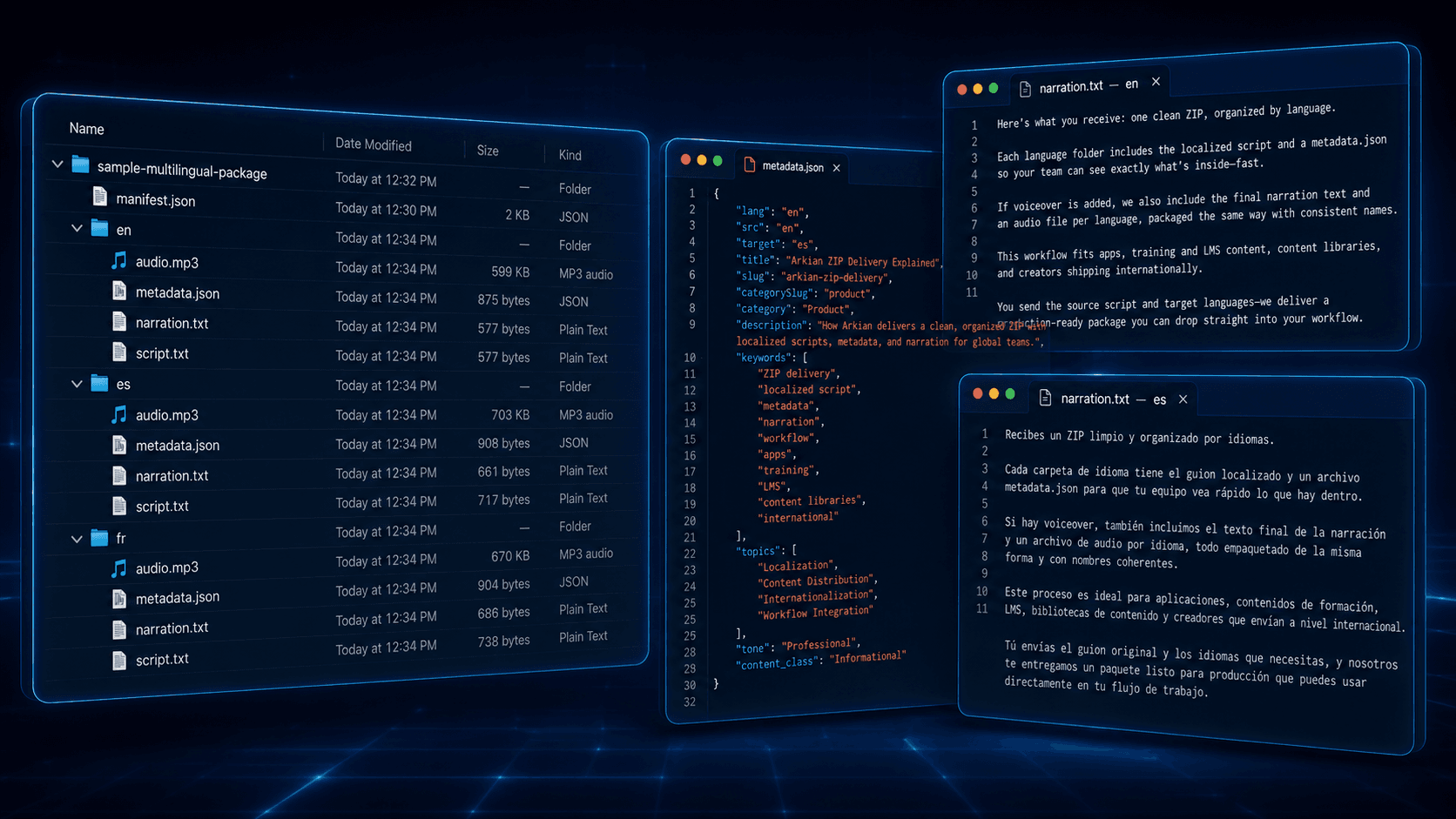
Structured context for the package.
Use metadata JSON when language assets need context that can be reviewed, stored, delivered, or used by the next system.
- Metadata is written manually after translation.
- Context differs by language or output type.
- The package lacks a clear manifest.
- Metadata is generated as part of the job.
- Context stays beside the deliverables.
- The package is easier to inspect and hand off.
Multilingual assets organized for review.
The customer brings approved source content. Arkian returns files organized for review, delivery, or release support.
String files
Localized copy with keys, placeholders, and file rules preserved.
Metadata files
Titles, descriptions, keywords, topics, and context in structured files.
Audio files
Translated scripts, approved narration text, MP3/WAV output, validation, and repair-ready language packages.
Packaged assets
Predictable language folders, a root manifest, recorded validation status, and a downloadable ZIP for handoff.
The package is the handoff.
Arkian keeps the output inspectable: named files, selected formats, language folders, and package context.
Inputs
- Approved source
- Metadata depth
- Languages
- Package settings
Outputs
- metadata.json
- Titles
- Descriptions
- Keywords
- Topics
- Context fields
A focused path from source to package.
The customer keeps control of the final system. Arkian prepares the multilingual assets and package structure.
Submit approved source.
Choose metadata options.
Generate metadata JSON.
Review it with the package.
For clear jobs that do not need a full localization stack.
Arkian can support apps, websites, voice prompts, kiosks, onboarding, support content, and other systems that need multilingual assets without a full CAT/TMS workflow.
Product builders
Localized app strings, metadata, help copy, release assets, and product-language files without connecting a repo.
Content teams
Approved scripts, articles, lessons, podcasts, and explainers turned into multilingual text, metadata, and voice files.
Small agencies
Client-ready multilingual packages without standing up a CAT/TMS, voice stack, metadata process, and file-prep workflow.
Customer-facing systems
IVR, voicemail, kiosks, SCO, EPOS, onboarding screens, support prompts, and other systems that need consistent copy or audio.
Operational teams
One focused multilingual job done cleanly: approved source in, structured output out, customer review stays in control.
More than raw translation.
Translation is one part. Arkian adds the structure around it: formats, folders, metadata, scripts, voice files, naming, and delivery-ready packages.
Core, extended, or richer metadata can be scoped to the job.
Metadata travels with the output package.
Useful for systems that need context beside content.
Customer controls final use.
Questions customers may have.
Is Arkian a CAT or TMS replacement?
No. Arkian prepares structured multilingual outputs from approved source content. Mature CAT/TMS platforms remain the better fit for translation memory, terminology governance, reviewer routing, and Git-native localization operations.
Does Arkian need repository access?
No. Arkian creates packages and files. The customer keeps their product, repository, CMS, IVR system, kiosk platform, or content system under their own control.
What does Arkian actually solve?
Arkian compresses the production work between approved source content and usable multilingual assets: strings, metadata, scripts, voice files, naming, folder structure, and downloadable packages.
Other Arkian workflows.
Create multilingual metadata from approved source content, including titles, descriptions, keywords, topics, and context packaged beside language assets.
Create semantic metadata from approved source with topics, keywords, summaries, descriptions, and context packaged beside multilingual assets for review.
Turn approved source content into multilingual strings, scripts, metadata, voice files, validation records, manifests, and organized delivery packages.
Create the multilingual assets this job needs.
Choose the output path, review the estimate, and download a structured package.
Open Arkian