Multilingual production without adopting a full localization stack.
Arkian helps developers, small teams, agencies, creators, and businesses turn approved source content into usable multilingual output: strings, metadata, scripts, voice files, and organized packages. It is not a CAT/TMS replacement. It is a focused production layer for jobs where enterprise localization infrastructure is more than the work requires.
For clear jobs that need usable multilingual assets.
Arkian fits when the customer already knows the content they need to produce and wants organized multilingual files they can inspect, review, and use in their own system.
- Enterprise localization tools feel too large for the job.
- Separate tools are needed for strings, metadata, scripts, audio, and packaging.
- The customer still wants control over review and final use.
- The job is scoped before it starts.
- Arkian returns the selected multilingual outputs as an organized package.
- The customer reviews the files and uses them where they fit.
Multilingual assets organized for review.
The customer brings approved source content. Arkian returns files organized for review, delivery, or release support.
String files
Localized copy with keys, placeholders, and file rules preserved.
Metadata files
Titles, descriptions, keywords, topics, and context in structured files.
Audio files
Translated scripts, approved narration text, MP3/WAV output, validation, and repair-ready language packages.
Packaged assets
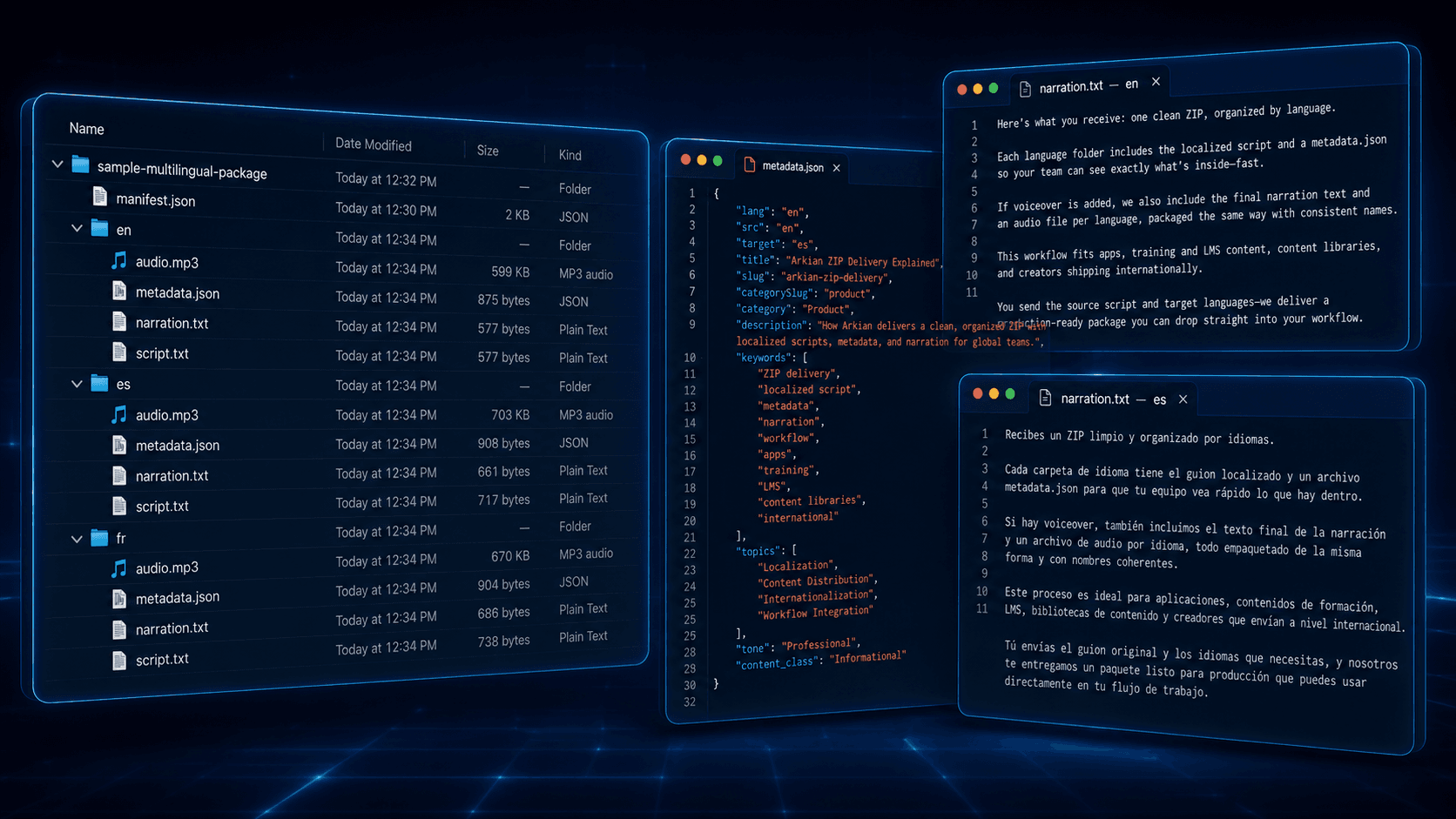
Predictable language folders, a root manifest, recorded validation status, and a downloadable ZIP for handoff.
The package is the handoff.
Arkian keeps the output inspectable: named files, selected formats, language folders, and package context.
Inputs
- Approved source copy
- Selected languages
- Output path
- Optional voice or metadata settings
Outputs
- Localized scripts
- String files
- Structured metadata
- Voice/audio files
- Language-organized packages
A focused path from source to package.
The customer keeps control of the final system. Arkian prepares the multilingual assets and package structure.
Choose the production lane that matches the job.
Add approved source content and selected languages.
Review the estimate before submission.
Download the structured package for checking, delivery, or release support.
For clear jobs that do not need a full localization stack.
Arkian can support apps, websites, voice prompts, kiosks, onboarding, support content, and other systems that need multilingual assets without a full CAT/TMS workflow.
Product builders
Localized app strings, metadata, help copy, release assets, and product-language files without connecting a repo.
Content teams
Approved scripts, articles, lessons, podcasts, and explainers turned into multilingual text, metadata, and voice files.
Small agencies
Client-ready multilingual packages without standing up a CAT/TMS, voice stack, metadata process, and file-prep workflow.
Customer-facing systems
IVR, voicemail, kiosks, SCO, EPOS, onboarding screens, support prompts, and other systems that need consistent copy or audio.
Operational teams
One focused multilingual job done cleanly: approved source in, structured output out, customer review stays in control.
More than raw translation.
Translation is one part. Arkian adds the structure around it: formats, folders, metadata, scripts, voice files, naming, and delivery-ready packages.
No repo access required.
No runtime code changes required.
Outputs include JSON, TypeScript, iOS .strings, Android XML, YAML, structured metadata, MP3, and WAV.
Quiet Harbour uses Arkian-generated multilingual assets in a shipped product experience.
Questions customers may have.
Is Arkian a CAT or TMS replacement?
No. Arkian prepares structured multilingual outputs from approved source content. Mature CAT/TMS platforms remain the better fit for translation memory, terminology governance, reviewer routing, and Git-native localization operations.
Does Arkian need repository access?
No. Arkian creates packages and files. The customer keeps their product, repository, CMS, IVR system, kiosk platform, or content system under their own control.
What does Arkian actually solve?
Arkian compresses the production work between approved source content and usable multilingual assets: strings, metadata, scripts, voice files, naming, folder structure, and downloadable packages.
Other Arkian workflows.
Turn approved source content into multilingual strings, scripts, metadata, voice files, validation records, manifests, and organized delivery packages.
Package multilingual strings, scripts, metadata, audio, manifests, and language folders into organized ZIPs that are easy to inspect, review, and deliver.
See how Quiet Harbour, a shipped iOS app from Quiet Harbour Inc., uses Arkian-produced multilingual strings, metadata, content, audio, and language packages.
Create the multilingual assets this job needs.
Choose the output path, review the estimate, and download a structured package.
Open Arkian