
90 Day Chatbot Script Localization for Developers: QA, A11y, Arkian
90 Day Chatbot Script Localization for Developers: QA, A11y, Arkian

A production-ready localization workflow decouples your chatbot strings into keyed locale packages, initializes language through session or embed parameters with a safe priority chain, and tags every string with BCP 47 metadata for accessibility. Your first move: add lang attributes to response payloads and implement a selected_language session attribute. Pair this with native-speaker review and accessibility testing before shipping any new locale.
TL;DR:
- Implement locale-specific resource files with clear metadata, including direction, context, and placeholders, instead of hardcoding strings in conversation logic.
- Use a layered language detection system starting with user preferences and falling back to browser signals or automatic detection, with explicit user confirmation for language switches.
- Package translations into modular per-locale files to simplify updates, ensure accessibility, and support text-to-speech pronunciation without duplicating content.
- Conduct thorough manual and automated QA, including native-speaker reviews and accessibility tests, before deploying new locales to catch tone, formatting, and detection issues.
- Track key metrics such as CSAT, intent accuracy, and fallback rates per locale, rolling out new languages gradually with feature flags and continuous iteration.
Table of Contents
- Why localization architecture decisions matter early
- Language detection and safe fallback patterns
- String management and modular packaging for scalable localization
- Making conversations feel native, not translated
- Wiring language choice into session, API, and channel logic
- How to test and QA localized chatbot scripts
- Deploying, monitoring, and iterating safely
- How Arkian helps small teams ship localized scripts and voice outputs
- A 90-day roadmap for localization rollout
- How to evaluate Arkian for your localization pipeline
- FAQ
- Sources
- Standards and platform docs developers should read next
Why localization architecture decisions matter early
A chatbot that only speaks one language caps its own reach, and the way you architect multilingual support determines whether adding a locale takes a day or a quarter. Getting the foundation right early avoids a rebuild later.
Three implementation strategies cover most cases:
- Platform multilingual agents: use built-in multilingual features (like Dialogflow CX’s root and locale-specific language model) when your platform supports native detection and routing.
- Translation layer: run a single flow through a translation service at runtime, which is fast to deploy but weak on idioms and tone.
- Separate per-locale flows: build independent conversation flows per language, which gives the most control but multiplies maintenance work with every flow change.
Per-locale flows scale poorly once you pass three or four languages, since every intent update has to be replicated manually across each flow. Teams that decouple strings into external resource files instead of duplicating logic avoid most of that overhead, a pattern Oracle’s chatbot documentation also recommends for keeping translations separate from bot code.
Language detection and safe fallback patterns
Language selection should follow a predictable chain rather than guessing from a single signal. Each step only fires when the one before it is unavailable or inconclusive:
- Explicit user preference: a language picker or a stored account setting always wins first.
- Channel or page locale: the locale of the page or messaging channel the conversation started from.
- Browser or header signal:
Accept-LanguageorNavigator.languages, read as a hint rather than a final answer, since MDN’s documentation notes these can reflect shared devices or stale settings. - Input auto-detection: detect language from the user’s first message when no other signal exists.
- Configured fallback: a default root language (commonly
en) when every other signal fails.
Normalize incoming tags to BCP 47 before matching, and map locale-specific variants like en-GB or es-MX back to a root language (en, es) when no locale-specific content exists, a pattern Dialogflow CX’s design guidance recommends avoiding duplicating content unnecessarily.
A minimal flow looks like this in pseudocode:
if session.selected_language exists: use it
elif page_locale detected: setSessionAttributes(selected_language = page_locale)
elif accept_language header present: propose it, don't force it
elif detection_confidence > threshold: setSessionAttributes(selected_language = detected)
else: setSessionAttributes(selected_language = default_fallback)
Avoid switching languages mid-conversation without telling the user. If detection confidence drops on a later turn, a quiet language flip feels like a bug, not a feature. Surface a short confirmation instead, and always keep a visible way to change language manually.
Pro Tip: Log detection confidence scores alongside the final language choice so you can tune your threshold without guessing.
String management and modular packaging for scalable localization
Hardcoding strings inside conversation logic is the single biggest blocker to adding a new language later. The fix is a resource-bundle pattern: every user-facing string gets a key, and the flow logic references the key, never the literal text.
Each entry in your resource bundle should carry more than the translated string itself:
- Locale tag: a normalized BCP 47 code (
fr-CA,pt-BR) so the renderer knows exactly which variant it is serving. - Direction:
ltrorrtl, since mixing scripts without this flag breaks rendering in bidirectional contexts. - Context key: a short note on where and how the string is used, which keeps translators from guessing at tone or audience.
- Placeholder markers: tokens like
{user_name}or{order_date}flagged explicitly so automated checks can confirm they survive translation intact.
Package these as modular per-locale files (JSON or YAML) rather than one monolithic translation file. A folder structure like /locales/en/common.json, /locales/es/common.json keeps merge conflicts rare, since two translators working on different languages never touch the same file. W3C guidance on localizable manifests recommends exactly this kind of modular packaging over single-file approaches, partly because it lets automated tooling validate and ship one locale at a time without touching the rest.
This structure also doubles as a prerequisite for accessibility and text-to-speech output. Each string’s lang and dir metadata tells a screen reader or TTS engine which pronunciation rules to apply, which matters even more once a single response mixes a product name in one language with surrounding text in another. Teams managing their own folder conventions can find a working reference in Arkian’s guidance on multilingual output structure, built around the same locale-per-file logic.

Making conversations feel native, not translated
A technically correct translation can still feel foreign if the tone, formatting, or references do not match local conventions. Several dimensions need deliberate handling rather than a blanket translate-everything pass:
- Formality and register: some languages (German, Japanese, Korean) carry grammatical formality levels that English does not; store a formality attribute per locale rather than hardcoding one tone.
- Dates, numbers, and currency: use locale-aware formatting libraries so
03/04/2026doesn’t ambiguously mean March 4 in one locale and April 3 in another. - Idioms and named entities: direct translation of idioms often reads as nonsense, so flag idiomatic phrases for linguist review rather than machine translation alone.
- Right-to-left handling: for Arabic, Hebrew, and similar scripts, pair the
dirattribute with CSS logical properties instead of hardcoded left and right values, since a layout built with fixedleft/rightrules breaks the moment it renders right to left.
Bring in a native-speaker reviewer for any locale where idiom density is high or where formality mistakes carry real social weight. A reviewer catches tone mismatches that automated QA simply cannot detect.
Pro Tip: Keep a glossary of brand and product names that should never be translated, and mark them explicitly in your resource bundle so neither translators nor TTS engines alter them.
Wiring language choice into session, API, and channel logic
Once you have decided how a language gets selected, the harder part is making sure every downstream system respects that choice consistently.
- Persist the choice in session state: store
selected_languageas a session attribute immediately after detection or user selection, and reference it on every subsequent response lookup rather than re-detecting each turn. - Set language fields on every API call: pass
languageCode(or the equivalentqueryInput.languageCodefield in platforms like Dialogflow CX) explicitly, and enable auto-detection at both agent and flow level where the platform supports it, which returns a confidence score alongside the resolved language. - Propagate locale through widget embeds: use embed parameters and
onReadyhooks to pass the page’s detected locale into the chat session at load time, a pattern Chatbot documents through its ownsetSessionAttributesand embed parameter approach. - Map locale signals per channel: a voice channel has no
Accept-Languageheader to read, so it depends more heavily on account-level locale settings, while a web widget can combine page locale, browser hints, and explicit user choice.
Chatbots that detect and confirm language early in a conversation reduce the risk of routing a user into the wrong flow entirely, since a single bad early detection can derail an entire session if nothing downstream rechecks it. Building a recheck point after the first two or three turns catches these cases before they compound.
Treat voice and text channels differently for fallback behavior too: a voice bot that fails to detect language confidently should default to a neutral prompt asking the caller to choose, rather than guessing and potentially responding in the wrong language entirely.
How to test and QA localized chatbot scripts
A localized script is not ready to ship until it has passed both automated and human review. Work through these checks before every locale launch:
- Automated static checks: confirm every string carries a
langattribute, every placeholder token ({user_name}) survived translation unaltered, and text encoding is valid Unicode throughout. - Linguistic QA: run full in-channel walkthroughs with a native speaker for each locale, using sample conversations that cover your most common intents, not just a handful of strings in isolation.
- Accessibility QA: mark language changes inside mixed-language responses per WCAG’s language-of-parts guidance, then test with a screen reader to confirm pronunciation switches correctly when the language changes mid-response.
- Edge-case tests: simulate low-confidence detection, force the fallback path, and test turns where a user mixes two languages in one message to confirm the bot does not break or loop.
Code-switching, where a user types a sentence that blends two languages, is one of the most common real-world edge cases and one of the least tested. Build at least a handful of test conversations that intentionally mix languages to see how your detection and routing handle it before launch.
Pro Tip: Keep a standing set of regression test conversations per locale so a flow update in one language does not silently break tone or routing in another.
Deploying, monitoring, and iterating safely
Launching a new locale is the start of the work, not the end. Track a focused set of metrics per locale rather than aggregating everything into a single global number:
- CSAT by locale: satisfaction scores that blend languages hide exactly the locale that needs attention.
- Intent accuracy by locale: a drop in accuracy for one language often points to translation quality, not model quality.
- Fallback and escalation rates: a locale with high fallback rates usually signals missing content or detection errors, not a model failure.
Roll out new locales behind feature flags so a problematic translation or broken flow can be reverted instantly without a full redeploy. Stage releases to a small percentage of traffic in that locale first, and widen the rollout only once metrics hold steady.
Log detection confidence scores and anonymized example inputs that triggered low-confidence routing, since this data is what actually improves both your NLU model and your translation quality over time. Reserve human translation for your highest-traffic intents and fall back to automated translation only for long-tail content where volume makes manual review impractical.
How Arkian helps small teams ship localized scripts and voice outputs
Localization work stalls most often at the production step: turning approved source strings into validated, packaged files ready for release. We built our platform to automate that step for small teams, generating multilingual scripts, voice (TTS) output, and structured metadata without requiring repository access or a full translation management system.
A small product team adding two or three new locales before a release deadline is the clearest fit: we handle translation of app strings, generate matching TTS narration, and package everything into delivery-ready JSON, iOS strings, Android XML, or YAML files, already validated and organized by locale. Our work with the Quiet Harbour app shows this pipeline producing a coherent localized experience across multiple languages without the overhead of a traditional TMS setup.
A 90-day roadmap for localization rollout
Rather than localizing everything at once, we recommend a staged approach that limits risk while you build internal muscle:
- Weeks 1 through 4: pick one or two target locales, decouple existing strings into keyed resource files, and implement session-based language initialization.
- Weeks 5 through 8: add locale-specific variants for formality and formatting, run native-speaker QA on full conversation flows, and attach
langmetadata to every string. - Weeks 9 through 12: roll out behind feature flags to a small percentage of traffic, monitor CSAT and fallback rates by locale, and iterate on anything that underperforms.
Assign clear ownership early: one person owns the resource bundle and key naming conventions, another validates TTS output for pronunciation accuracy, and someone on the product side watches the production metrics weekly once the locale is live.
How to evaluate Arkian for your localization pipeline
If your team is choosing between building this pipeline from scratch or automating the production step, we package multilingual strings, TTS narration, and structured metadata into validated, delivery-ready files without requiring repository access or TMS setup.
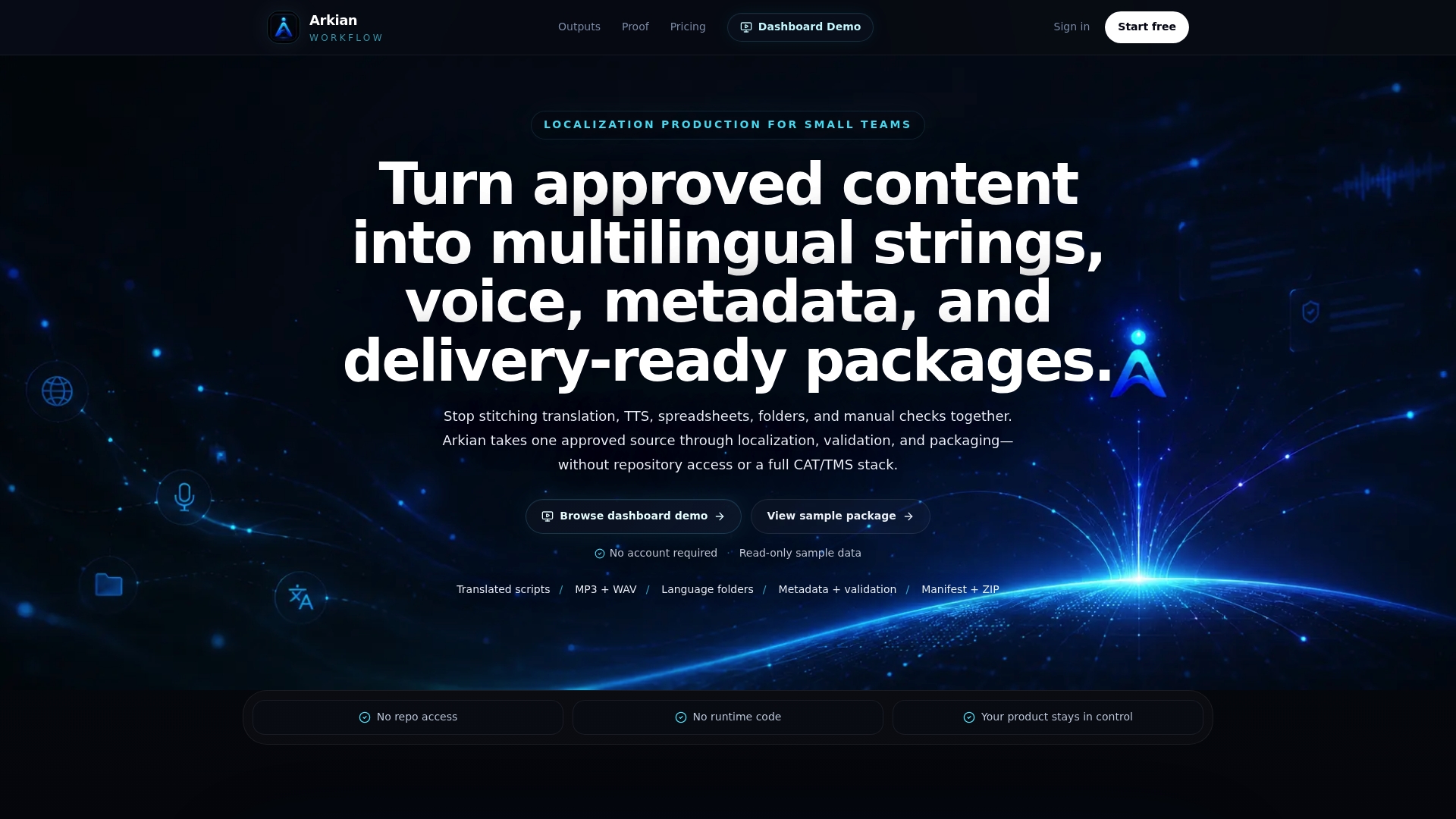
Teams juggling a tight release calendar and a small headcount tend to see the most benefit, since the manual packaging work is exactly what slows a release down. Our Starter plan runs $29.00 CAD one-off, or review our full pricing page to compare it against our monthly membership option.
FAQ
What is the best architecture for chatbot script localization?
Decouple user-facing strings into keyed locale files, initialize language through session attributes with a safe fallback chain, and tag every string with BCP 47 locale metadata. This keeps translation work separate from conversation logic and lets you add a new language without touching bot code.
How does automatic language detection work in a chatbot?
Detection typically follows a priority chain: explicit user choice first, then page or channel locale, then browser signals like Accept-Language, then input-based detection, with a configured default as the final fallback. Dialogflow CX returns a confidence score alongside detected language so you can decide when to trust it automatically versus asking the user to confirm.
Why should chatbot strings be stored separately from conversation logic?
Separating strings into resource bundles lets translators and automated tools update content without editing the underlying flow code, which speeds up releases and reduces QA risk. Oracle’s chatbot localization documentation recommends this decoupling specifically to avoid duplicating logic across languages.
What accessibility rules apply to multilingual chatbot responses?
WCAG’s language-of-parts guidance requires marking language changes within content so screen readers and text-to-speech engines apply correct pronunciation. This matters most when a single response mixes a brand name or product term in one language with surrounding text in another.
Should chatbots use machine translation or human translation?
Machine translation works reasonably well for long-tail, low-traffic content where volume makes manual review impractical, but high-traffic intents and anything involving tone or idiom benefit from native-speaker review. Many teams use automated translation as a first pass, then route high-visibility strings through human QA before release.
Sources
- Chatbot
- Multilingual agents | Dialogflow CX | Google Cloud Documentation
- Internationalization best practices for spec developers (W3C)
- Navigator.languages - MDN Web Docs
Standards and platform docs developers should read next
A handful of primary references cover most of the technical decisions in this guide. W3C’s internationalization guidance for specification developers details per-string language and direction metadata requirements. WCAG’s language-of-parts success criterion explains the accessibility reasoning behind marking language changes. Dialogflow CX’s multilingual agent documentation covers root versus locale-specific language design, and MDN’s Navigator.languages reference explains the limits of browser-based detection. Chatbot offers a concrete platform example of session-based language initialization. For automating language metadata checks across deployments, this guide on hreflang automation in CI/CD is a useful parallel reference.