
Save 3–8 developer hours per release: App localization for small teams
Save 3–8 developer hours per release: App localization for small teams
Simple apps typically cost a moderate amount per word for human translation per language, resulting in a modest total cost for a small app with a few thousand words of text. Complex apps with heavy UI strings, voice-over, and full linguistic QA push that to $2,000 to $8,000 or more per language. The three variables that move the number most: total string and word volume, how many languages you’re targeting at once, and how much human QA versus machine translation you build in.
TL;DR:
- App localization costs vary widely depending on app complexity, with small apps around 500 strings costing roughly $450 per language, while complex apps with multimedia and voice-over can reach over $100,000 for multiple languages.
- The total quote can differ significantly due to line items such as translation, engineering, QA, design assets, and project management, with each component contributing to the overall expense.
- Human translation costs can be reduced by using machine translation post-editing, which typically saves 40% to 60% compared to full human translation, especially for basic UI strings.
- Recurring expenses for updates and maintenance often account for 10% to 25% of initial localization costs annually and increase with faster release cycles or additional language additions.
- Automation tools like Arkian can streamline workflows and reduce developer overhead by delivering pre-packaged multilingual content without the need for a full TMS, making localization more feasible for small teams.
Table of Contents
- How Much Does App Localization Cost by Project Size?
- What Are You Actually Paying For?
- Per-Word, Per-String, or Subscription: Which Pricing Model Fits?
- Running the Numbers Yourself
- Do iOS, Android, and Web Cost Different Amounts to Localize?
- The Recurring Costs Nobody Puts in the Initial Quote
- Building Your Own Localization Budget Worksheet
- Where Arkian Fits in the Cost Equation
- Spend on What Users Notice, Automate What They Don’t
- A Practical Next Step for Small Teams
- Sources
- FAQ
How Much Does App Localization Cost by Project Size?
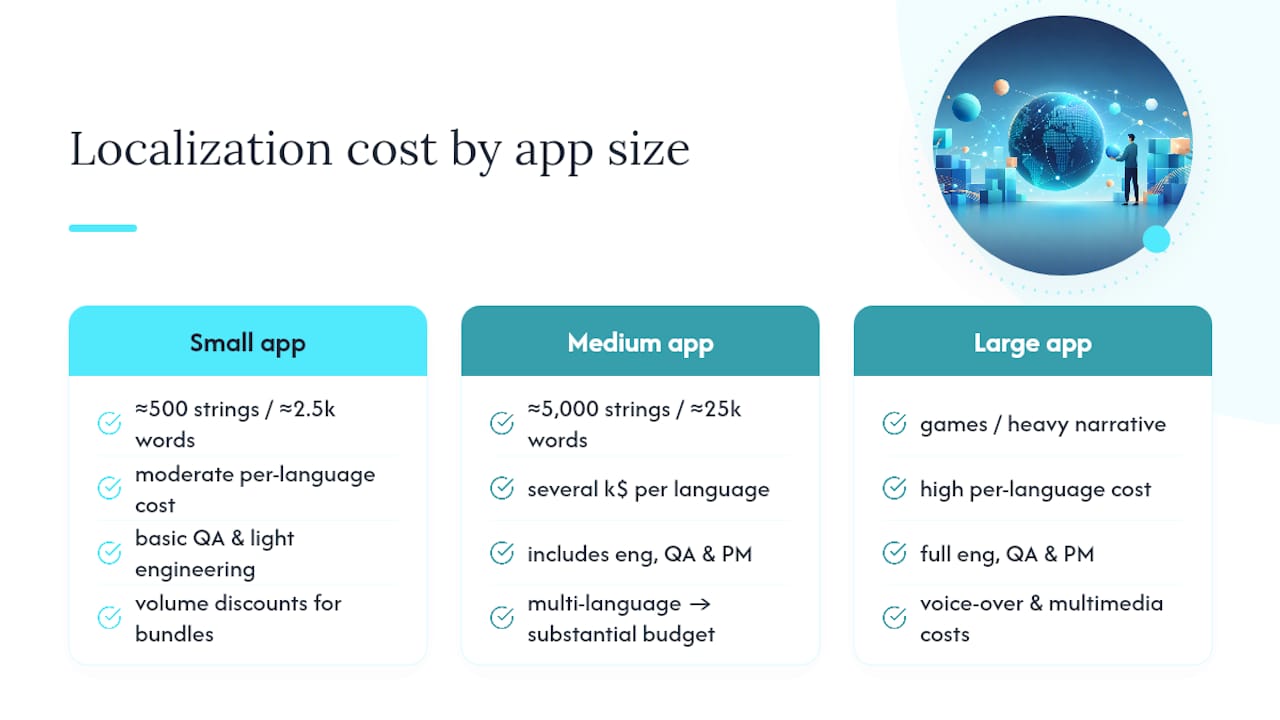
Budgets scale in three fairly predictable tiers. Where your app lands determines which numbers matter.
A small app with around 500 strings, roughly 2,500 words, is the cheapest tier to localize and the easiest to get wrong on quality if you cut corners. At typical rates for professional human translation, the per-language translation cost falls within a certain moderate range. Adding basic QA and light engineering increases the cost to a reasonable total per language. When bundling multiple languages, vendors often offer volume discounts on the per-word rate, lowering the total cost for a multi-language rollout.
A medium app, say 5,000 strings and 25,000 words, is where the line items start to separate. Translation for medium-sized apps costs several thousand dollars per language at standard rates. When including engineering, QA, and project management, the single-language cost is higher. Multiplying across multiple target languages results in a substantial budget for a full localization effort before ongoing maintenance.
Large or complex apps, particularly games or apps with heavy narrative content, add a category of cost most budget spreadsheets miss entirely: voice-over and multimedia. Recording professional voice talent in a single language can range widely in cost depending on script length and studio time, and these costs multiply with each target language. A large mobile game localizing into 12 languages with voice assets can easily clear $100,000.
One factor softens all three tiers over time: translation memory. Once a string has been translated and reused, most vendors and tools apply a substantial discount on the rate, reflecting the reduced effort for repeat releases that affect only a subset of strings.
What Are You Actually Paying For?
A localization quote is never one number. It’s five or six line items stacked together, and vendors bundle them differently, which is exactly why two quotes for the “same” project can differ by thousands of dollars.
- Translation itself. Machine translation alone costs pennies per word or less; machine translation post-editing (MTPE), where a human corrects an AI draft, typically runs $0.04 to $0.10 per word; full human translation from scratch runs $0.08 to $0.20 per word depending on language pair and subject complexity, per rate benchmarks from Nimdzi.
- Internationalization (i18n) engineering. This is developer time spent extracting hardcoded strings, handling pluralization rules, right-to-left layouts, and date/currency formatting. Budget anywhere from a few hours for a well-architected codebase to several weeks for a legacy app never built with localization in mind.
- Localization QA (LQA). Someone has to actually open the app in each language and confirm nothing overflows a button, truncates a label, or breaks a layout. This is separate from linguistic review and often billed hourly or per screen.
- Design and asset localization. Screenshots, onboarding videos, and marketing graphics with embedded text all need separate localization passes, and this line item gets forgotten more often than any other.
- Project management. Coordinating translators, engineers, and reviewers across ten languages doesn’t happen for free; agencies typically fold a 10% to 20% coordination fee into project-based quotes.
Pro Tip: Ask every vendor to itemize their quote by these five categories before you compare prices. A quote that only shows one lump number is hiding which corners get cut when a deadline slips.
Per-Word, Per-String, or Subscription: Which Pricing Model Fits?
Vendors price localization work in a handful of ways, and translating between them is the only way to compare quotes honestly.
- Per-word pricing is the industry standard for translation and the easiest to benchmark against public rate guides. It rewards concise UI copy and punishes verbose strings.
- Per-string pricing shows up in app-specific tools and averages out word count per key, usually assuming 5 to 8 words per string for typical UI text. A 5,000-string app at that ratio is roughly 25,000 to 40,000 words, which is how you convert a per-string quote back to a per-word comparison.
- Per-project pricing bundles translation, QA, and management into a flat fee, common for smaller apps where itemizing feels like overkill.
- Subscription or TMS pricing charges a recurring seat or platform fee regardless of volume, which only pays off once you’re shipping frequent updates across many languages and have the internal headcount to manage a translation management system.
MTPE is worth understanding on its own. DeepL’s state of localization research documents the shift toward hybrid machine-plus-human workflows, and the savings are real: MTPE typically runs 40% to 60% cheaper than pure human translation for straightforward UI copy, while marketing copy and anything emotionally sensitive still benefits from starting with a human translator rather than editing a machine draft.
A subscription TMS makes sense once you’re releasing monthly updates across eight or more languages with a dedicated localization coordinator. Below that threshold, a pay-per-release model or a production tool that skips the TMS entirely usually costs less.
Running the Numbers Yourself
Here’s the math behind the tier estimates above, so you can substitute your own string counts.
- Small app formula: (word count) × (per-word rate) + flat QA fee. Example: 2,500 words × $0.12 = $300, plus a $150 QA pass = $450 per language.
- Medium app formula: (word count × per-word rate) + (i18n engineering hours × developer hourly rate) + (QA hours × tester rate) + (10% to 15% project management). Example: 25,000 words × $0.11 = $2,750, plus 20 engineering hours at $60/hour = $1,200, plus $600 QA, plus 15% coordination = roughly $5,230 per language.
- Large app formula: add voice-over per finished minute of audio (varies widely by studio and language) and ASO asset localization per store listing on top of the medium-app formula.
Games and apps with heavy narrative or legal content are the special cases that blow up simple math. Fantasy or sci-fi terminology often demands a specialized translator charging a premium over general rates, and legal disclaimers or terms-of-service text frequently require certified translation, which can run double standard rates depending on jurisdiction.
Do iOS, Android, and Web Cost Different Amounts to Localize?
The translation cost is nearly identical across platforms. The engineering and store-listing costs are not.
Android apps use XML string resources, iOS apps use .strings files, and web or cross-platform apps typically rely on JSON, TypeScript, or YAML. None of these formats are harder to translate, but each has its own extraction quirks, and teams juggling both an Android XML build and an iOS strings build often duplicate engineering effort keeping the two in sync.
Store listing localization is its own line item. Google’s Play Console offers free automatic machine translation through Gemini models for app strings and store listings, alongside an optional paid human translation service billed per word, per Google’s own Play Console documentation. Apple’s App Store Connect has no equivalent free MT layer, so iOS teams typically pay for listing translation separately.
- Screenshot localization typically runs $20 to $75 per locale when done manually.
- Video and promo asset localization costs more, often $100 to $300 per locale depending on voice-over needs.
- Automating screenshot text swaps instead of re-rendering from scratch cuts this cost significantly on repeat releases.
The Recurring Costs Nobody Puts in the Initial Quote
The first localization invoice is rarely the expensive one. The second, third, and fortieth releases are where budgets quietly balloon.
- Developer integration time. Someone has to extract new strings, package them for translation, reintegrate the translated files, and push a release. For a team without automation, this can run 3 to 8 hours per release cycle, and at typical localization engineering salaries tracked by ZipRecruiter, that’s real money every single release.
- Ongoing maintenance. A common rule of thumb is budgeting 10% to 25% of your initial localization cost per year for updates, new features, and string churn.
- Release cadence penalties. Weekly or biweekly release cycles multiply the developer-hour cost above by however many cycles you ship, which is why teams releasing frequently feel localization costs far more than teams shipping quarterly.
- Slow external contributors. Waiting on a freelance translator’s turnaround time can delay a release by days, and rush fees for expedited turnaround typically add 25% to 50% to the base rate.
Automation tools that package translated files into ready-to-use formats, cutting the manual extraction and repackaging work, are specifically what shrinks that first line item.
Building Your Own Localization Budget Worksheet
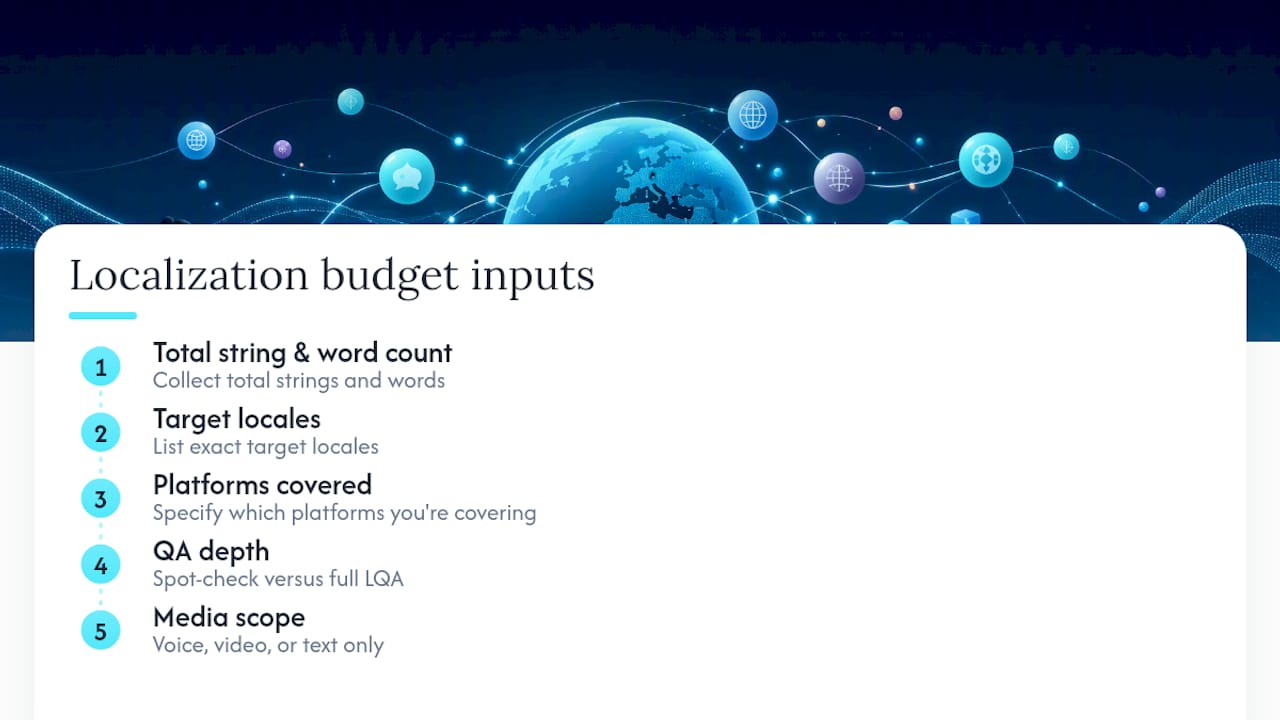
Before you request a single quote, collect five inputs: total string and word count, the exact list of target locales, which platforms you’re covering, the QA depth you need (spot-check versus full LQA), and whether you need voice, video, or just text.
When a vendor sends a quote back, it should specify: file packaging format and delivery method, whether translation memory discounts apply to repeat content, what happens after release (support window, bug fixes), any service-level agreement on turnaround, and how many review cycles are included before final sign-off.
Pro Tip: Run this calculation before you talk to a single vendor. Walking into a sales call with your own number means you’ll spot immediately whether a quote is padded or genuinely justified by scope.
Where Arkian Fits in the Cost Equation
Most of the recurring costs above, extraction, repackaging, repo integration, exist because localization workflows were built around enterprise TMS platforms that assume a dedicated localization team. Small teams rarely have that headcount.
- Arkian automates the creation of translated strings, TTS voice output, and structured metadata without requiring repository access.
- Output arrives pre-packaged into formats like JSON, iOS, Android, TypeScript, and YAML, cutting the developer hours normally spent reformatting vendor deliverables.
- Frequent release teams with limited localization engineering staff may see a reduction in per-release operational time.
- Its collaboration with the Quiet Harbour app demonstrates coherent multilingual output across languages without a full TMS deployment.
Spend on What Users Notice, Automate What They Don’t
The conventional advice to “just get a good translator” misses the actual budgeting question, which is where in the pipeline human judgment changes outcomes versus where it just adds cost. Human review earns its price on marketing copy, onboarding flows, and anything emotionally weighted. Users notice a clumsy welcome message. They rarely notice that your settings menu was polished by a machine and cleaned up by an editor.
MTPE and subscription automation tools are right for high-volume, low-emotional-stakes strings: settings labels, error messages, technical documentation. The rule of thumb: if a mistranslation would embarrass you in a screenshot, pay for human eyes. If it would just look slightly stiff, automate it and move on.
— Arkian
A Practical Next Step for Small Teams
Traditional localization vendors and TMS platforms are built for teams with a dedicated localization manager and a backlog to justify seat licenses. If that’s not your team, the math in this guide, developer hours, repackaging time, per-release coordination, gets expensive fast for exactly the reason those platforms weren’t designed for a five-person shop shipping updates every two weeks.
Arkian is a different route to the same production-ready outcome: automated translation, TTS voice generation, and structured multilingual packaging, delivered as validated files you drop straight into your build, without repository access or TMS onboarding.
If your team is weighing whether to hire a vendor by the word or build an in-house pipeline, start by comparing that cost against a subscription or credit-based production run through Arkian. Check who Arkian is built for to see if your team’s release cadence and language count match the profile, or head to Arkian’s homepage to see a sample output package before committing to a full localization budget.
Sources
Rate ranges and platform details in this guide draw on Google’s Play Console translation documentation, DeepL’s state of localization report, Nimdzi’s freelance pricing research, and Upwork’s translator hiring data.
FAQ
How much should I charge for translation per hour?
Freelance translators typically bill hourly rates varying by language pair and specialization, though most professional translation work is quoted per word rather than hourly, per rate data from Nimdzi.
What does app localization mean?
App localization means adapting an app’s text, layout, currency, date formats, and sometimes voice and imagery so it reads and functions naturally for users in a different language and region, going beyond simple word-for-word translation.
How much do game localizers make?
Game localizers often charge premium rates above standard app translation, reflecting specialized terminology and narrative tone work, though exact figures vary widely by studio, language pair, and project scope.
How much does it cost to translate an app?
A small app with roughly 2,500 words typically costs a moderate amount per language for professional translation and basic QA, while a medium app around 25,000 words runs several thousand dollars per language once engineering and project management are included.