
7 Stage Pipeline to Localize In App Voice Prompts for Developers
7 Stage Pipeline to Localize In App Voice Prompts for Developers

Use text-to-speech for most in-app voice prompts because it scales across languages without re-recording, and reserve pre-recorded audio for brand-critical moments or offline-first features where quality control matters more than flexibility. Locale selection runs on BCP 47 tags, pronunciation gets tuned with SSML, and the rest is engineering discipline. This guide covers platform code patterns for Android and iOS, packaging conventions, and a QA checklist you can run before every release.
TL;DR:
- Pre-recorded audio provides consistent quality and tone but requires manual re-recording for each language and UI change, increasing maintenance costs.
- Text-to-speech offers broader language support and easier updates, especially for dynamic content like names and numbers, reducing the need for multiple recordings.
- Locale selection relies on BCP 47 tags with fallback chains that prioritize exact matches and user preferences over headers to ensure correct voice asset routing.
- On Android, resource qualifiers automate locale resolution, while on iOS, persistent synthesizer instances prevent speech cutoff issues during playback.
- SSML markup enhances pronunciation accuracy for proper nouns and acronyms, with testing against specific voices key to maintaining quality across updates.
Table of Contents
- Choosing between pre-recorded audio and text-to-speech
- How BCP 47 locale tags drive audio and voice selection
- Building voice prompts on Android and iOS
- Getting pronunciation right with SSML
- Structuring audio files and metadata for scale
- Running a localization pipeline that catches problems early
- Testing and QA before you ship localized prompts
- How automated packaging simplifies this pipeline
- What we see teams get wrong most often
- A faster path to localized voice prompts
- Standards and documentation worth bookmarking
- Sources
- FAQ
Choosing between pre-recorded audio and text-to-speech
Pre-recorded audio wins on quality and brand consistency. A voice actor delivers a specific tone, pacing, and warmth that synthesized speech still struggles to match consistently, and once recorded, the file plays offline with zero latency. The tradeoff is maintenance: every UI change means a new recording session, and supporting ten languages means ten times the files, storage, and licensing to track.
TTS wins on coverage and flexibility. A single neural voice engine can speak dynamic content, such as a user’s name, an order number, or a changing price, without ever touching a recording studio. Language coverage expands to whatever the engine supports, and updates ship as text changes, not audio re-recordings.
Most production apps land on a hybrid model:
- Core UI lines (“Welcome back,” “Payment confirmed”) ship as pre-recorded audio for polish and offline reliability.
- Dynamic slots (names, addresses, dates, numbers) render through TTS because pre-recording every permutation is not practical.
- Safety-critical or legal disclaimers often stay pre-recorded so wording and tone never drift between releases.
- Long-tail or rarely used prompts default to TTS since the cost of professional recording rarely pays off for low-traffic content.
Operationally, pre-recorded audio adds a licensing line item and a release cadence tied to your voice vendor’s turnaround time. TTS shifts cost toward compute and API calls, and it removes the recording bottleneck entirely, which matters when you are shipping updates weekly rather than quarterly.
How BCP 47 locale tags drive audio and voice selection
BCP 47 is the tagging standard that identifies a language and, where needed, a region, script, or variant. A bare en covers English generically, en-US narrows it to American English, fr-CA targets Canadian French, and es-419 groups Latin American Spanish rather than tying it to one country. The W3C’s language tag guidance explains how these subtags combine to let an app target both a language and a specific regional variant, and the W3C’s broader locale documentation notes that special codes like es-419 exist precisely because a single country tag is often too narrow for a shared dialect.
Resolving a tag to an asset or voice follows a predictable fallback chain:
- Look for an exact match on the full tag, such as
fr-CA. - If none exists, fall back to the base language,
fr. - If the base language is missing too, fall back to the app’s configured default locale, often
enoren-US.
A simplified lookup might read:
function resolveLocale(requested, available, fallback):
    if requested in available: return requested
    base = requested.split('-')[0]
    if base in available: return base
    return fallback
Locale can come from the device setting, a user preference stored server-side, or an Accept-Language header on API requests. When these disagree, device or user preference should win over header-derived guesses, since a header often reflects browser configuration rather than the person’s actual choice.
Name audio assets after their resolved tag directly, such as welcome_fr-CA.mp3 or welcome_es-419.mp3, so the file system mirrors the same fallback logic your code already runs.
Building voice prompts on Android and iOS
Android resolves locale-specific resources automatically through its resource qualifier system. Audio files placed in res/raw-fr-CA/ take priority for Canadian French devices, falling back to res/raw-fr/ for other French locales, and finally to the unqualified res/raw/ directory as the default. The Android localization documentation is explicit that a complete default resource set is required, since a missing default combined with a missing locale-specific file causes a runtime error rather than a silent fallback.
- Keep a complete, unqualified default resource set at all times, even if every string is also translated.
- Use qualifiers like
raw-es-rESsparingly, and only when a country-specific variant genuinely differs from the base language. - Store TTS strings separately from pre-recorded audio filenames so a build script can validate both independently.
On iOS, text content lives in localized .strings files, while pre-recorded audio ships as bundled assets keyed by locale folder. For synthesized speech, AVSpeechSynthesizer handles playback, but it must be retained as a persistent property rather than a local variable. A community-documented bug shows that a synthesizer created as a short-lived local variable gets reallocated mid-speech, cutting off audio unpredictably. Store the instance at the class or manager level and queue multiple utterances through that single instance rather than creating a new one per prompt.
Select the voice by locale using AVSpeechSynthesisVoice(language:), passing the resolved BCP 47 tag. Some navigation and mapping SDKs, including Magic Lane’s iOS voice guidance, expose separate controls for device TTS versus bundled human voices, letting an app set a TTS language explicitly or fall back to a named recorded voice when one exists for that locale.
For web and cross-platform apps, detect locale from the browser’s language settings or a stored user preference, then route to either the Web Speech API or a cloud TTS service. Build an explicit fallback path for locales your TTS provider does not support, defaulting to text display alone rather than failing silently.
Getting pronunciation right with SSML
SSML (Speech Synthesis Markup Language) wraps plain text with tags that control how a TTS engine speaks it. The core elements are <speak> as the root, <voice> to select a specific voice, <lang> to set the spoken language for a fragment, and <prosody> to adjust rate, pitch, or volume. Microsoft’s SSML pronunciation documentation covers these elements in detail, including how they interact with locale-specific voices.

For proper nouns, brand names, or acronyms that a TTS engine mispronounces by default, <phoneme> lets you specify exact pronunciation, and a custom lexicon applies the same correction across every prompt that uses that term. Supported phonetic alphabets vary by voice and locale, so a phoneme string that works for one language’s voice may not resolve correctly for another.
A short example:
<speak version="1.0" xml:lang="en-US">
  <voice name="en-US-JennyNeural">
    Your order from <phoneme alphabet="ipa" ph="ˈkwaɪ.ət ˈhɑːr.bər">Quiet Harbour</phoneme> has shipped.
  </voice>
</speak>
Multilingual apps sometimes need to mix languages inside one utterance, such as a brand name that stays in its original language within an otherwise translated sentence. Microsoft’s documentation on multilingual voices shows that neural voices can autodetect the language of a fragment or be told explicitly via nested <lang> elements, which is the more reliable approach for short brand terms embedded in a longer localized sentence.
- Always wrap phoneme tags with a plain-text fallback nearby so a TTS engine that rejects the tag still reads something sensible.
- Test every phoneme and lexicon entry against the exact voice used in production, not just any voice in the same language family.
- Log and monitor SSML parsing errors in CI rather than discovering them from user reports, since an unsupported phonetic symbol or malformed tag can return an outright request failure.
Pro Tip: Keep a small SSML test suite of your trickiest proper nouns and acronyms, and rerun it every time you upgrade a TTS voice model, since pronunciation behavior can shift between model versions.
Structuring audio files and metadata for scale
A predictable directory structure turns localization from a manual scavenger hunt into something a script can validate automatically. A pattern like base/prompts/<prompt_id>/<locale>/<variant>.mp3 keeps every language variant of a given prompt in one place, with the prompt ID stable across releases even as translations change.
- Use lowercase, hyphenated prompt IDs (
order-confirmed,payment-failed) that never change once a prompt ships, so historical references stay valid. - Store one file per locale under that prompt’s folder, named by BCP 47 tag rather than a display name like “French” or “Spanish.”
- Separate TTS-generated files from human-recorded ones in metadata, even if they live in the same directory, so QA knows which review process applies.
Each prompt needs a metadata record alongside the audio itself: an id, the source text, the resolved locale, a boolean flag for whether SSML was used, the voice identifier that generated or recorded it, duration_ms for playback validation, and a checksum to detect silent corruption or accidental overwrite.
For file format, compressed formats like MP3 or AAC at a moderate bitrate (64 to 96 kbps for spoken voice) balance file size against clarity on mobile connections, while WAV remains useful for a studio master before compression. Bitrate choices matter more at scale: a hundred short prompts in ten languages adds up quickly in app bundle size if every file is uncompressed.
Consistent metadata is what makes automated ingestion possible. A build pipeline can check for missing locales, flag duration outliers, and verify checksums without a human opening every file, which is the difference between a localization process that scales to twenty languages and one that collapses under its own manual overhead past three or four.
Running a localization pipeline that catches problems early
A voice prompt pipeline breaks into clear stages, each with its own validation gate before work moves forward.
- Extraction: pull source strings and prompt IDs from the app into a structured format.
- Translation: convert source text into target languages, preserving placeholders for dynamic content.
- SSML and lexicon pass: apply pronunciation markup and locale-specific lexicon entries where needed.
- Voice generation: run text through TTS or send scripts to voice talent for recording.
- Packaging: assemble audio, metadata, and text into the directory structure your app expects.
- Validation: run automated checks before anything ships.
- Release: bundle validated assets into the app build or a downloadable content pack.
Automated validation should include a presence matrix confirming every prompt ID has a file for every supported locale, an SSML lint pass that catches malformed tags before they hit a TTS API, duration threshold checks that flag a prompt running suspiciously long or short compared to its source, and checksum verification to catch silent file corruption between pipeline stages.
At runtime, fallback logic should prefer pre-recorded audio when it exists for the resolved locale, fall back to TTS when it does not, and fall back to on-screen text alone if neither audio path is available:
function playPrompt(id, locale):
    if hasRecording(id, locale): playAudio(id, locale)
    elif ttsAvailable(locale): speak(getText(id, locale))
    else: showText(getText(id, fallbackLocale))
Synthesizer retention rules apply here directly: keep a single TTS engine instance alive for the lifetime of the screen or session rather than instantiating one per prompt, and queue utterances through that instance instead of firing overlapping speech requests.
Pro Tip: Run your presence-matrix check as a CI gate that blocks merges, not just a warning, since a missing locale file is far cheaper to catch before release than after.
Testing and QA before you ship localized prompts
Functional testing should run both on real devices and in CI: confirm locale selection resolves correctly, fallback paths trigger when expected, and playback does not stall or cut off mid-sentence. Linguistic QA is a separate pass, ideally involving a native speaker reviewer for languages your team does not speak fluently, since a technically correct translation can still sound stilted or culturally off when spoken aloud.
- Check TTS latency on lower-end devices, since a noticeable delay before speech starts can feel like a bug rather than a design choice.
- Verify offline fallback behavior for any prompt that normally relies on a network-based TTS call.
- Confirm users can mute, skip, or adjust the volume of voice prompts, since forced audio without user control is an accessibility and usability problem.
- Build a test matrix crossing locales, device types, and prompt categories (critical, informational, dynamic) so coverage gaps are visible rather than assumed.
A useful reference point: Microsoft’s SSML documentation recommends testing lexicon and phoneme entries against the specific production voice, since pronunciation support is not uniform across every voice in a given language. Treat that as a standing QA step rather than a one-time check, since voice models get updated by vendors on their own schedule.
How automated packaging simplifies this pipeline
Arkian automates several of the stages described above: generating multilingual scripts from source text, producing TTS or human voice output for each locale, creating the metadata record for every prompt, and packaging everything into a delivery-ready bundle. Instead of a team manually tracking which locale has which file, Arkian’s multilingual voice production service outputs structured packages with the metadata fields a validation pipeline expects already attached.
Because validation and packaging happen before delivery, small teams do not need repository access or a full translation management system to receive reviewable, drop-in assets. Arkian’s collaboration with the Quiet Harbour app shows this in practice: a single source app producing a coherent set of localized voice assets across multiple languages, packaged in a form a small team can review and ship without building the pipeline described in this guide from scratch.
What we see teams get wrong most often
The most common failure we see is not a translation error, it is an engineering gap: missing fallback files that only surface when a user’s device locale does not match anything the team tested. A close second is the AVSpeechSynthesizer reallocation bug, where a developer creates the synthesizer as a local variable and speech cuts off unpredictably in production but never in the debugger. Inconsistent file naming across locales is the third repeat offender, quietly breaking automated ingestion scripts that assume a strict pattern.
For small teams, assign clear ownership early: one person owns source scripts and prompt IDs, one owns SSML and lexicon entries, one owns TTS or recording generation, and one runs QA before release. It does not need to be four different people. The minimum viable check before shipping is a presence matrix and a synthesizer retention review. Skip everything else before you skip those two.
— Arkian
A faster path to localized voice prompts
If the pipeline above sounds like a lot to build and maintain, that is because it is, and it is exactly what Arkian automates for small teams that do not have a dedicated localization engineer.
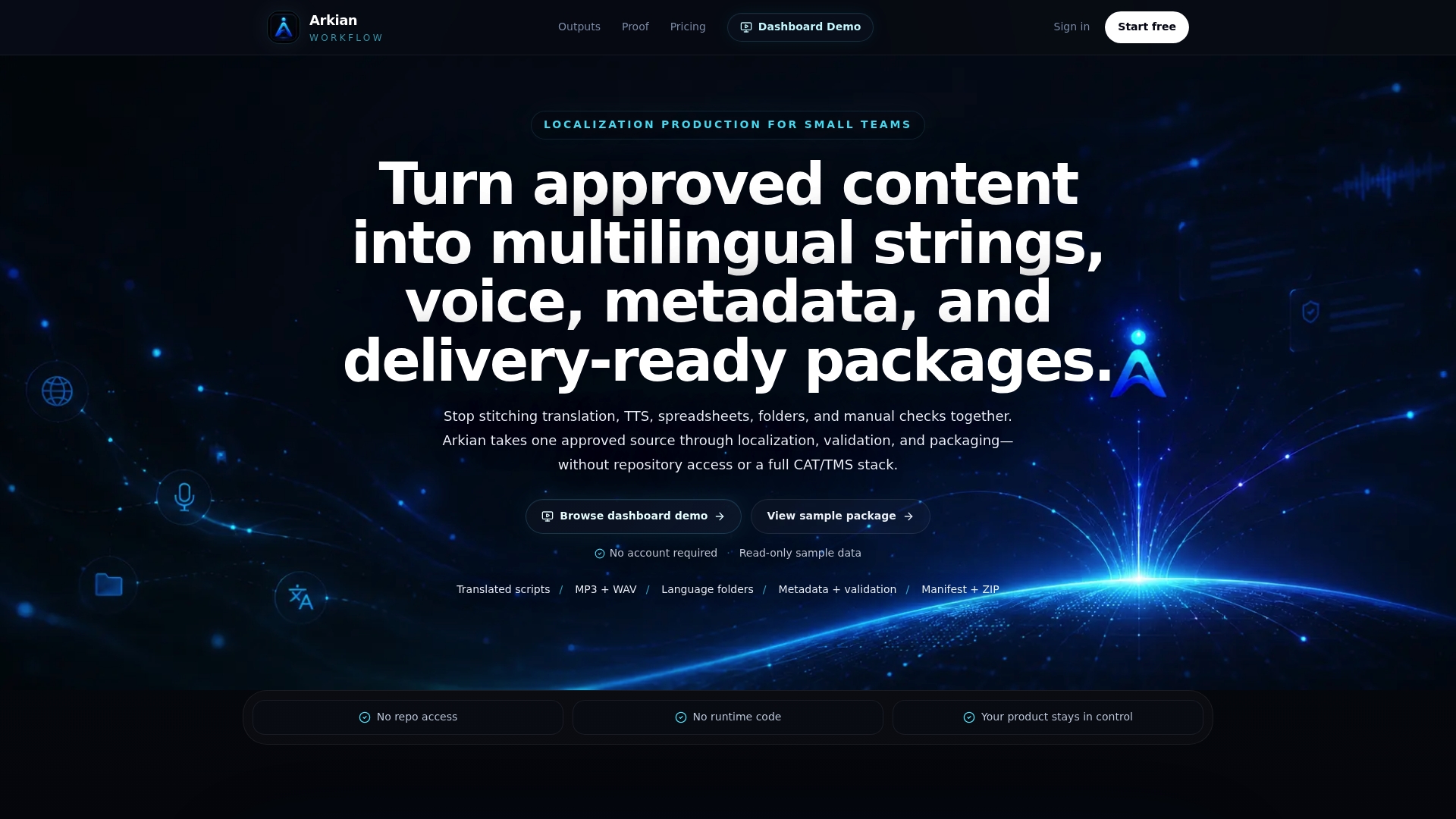
Arkian handles multilingual voice production, generates the metadata fields your validation checks expect, and packages the output into structured, review-ready files, whether you need localization strings in JSON, iOS, Android, or YAML format, or structured packaging ready for your CI pipeline. Teams that also need broader multilingual content beyond voice prompts can pair this with multilingual content services for a wider localization footprint. Check current plans and pricing on Arkian’s pricing page to see which option fits your team’s release cadence.
Standards and documentation worth bookmarking
For locale tagging itself, the W3C’s language tag and locale identifier guidance is the reference to keep close at hand. For pronunciation control, Microsoft’s SSML pronunciation docs and its multilingual voice documentation cover both syntax and multilingual voice switching in detail. Platform-specific behavior is best confirmed directly against the Android localization guide and Apple’s developer documentation for AVSpeechSynthesizer, since both are updated independently of any third-party summary.
Sources
- Language Tags and Locale Identifiers for the World Wide Web (W3C)
- Pronunciation with Speech Synthesis Markup Language (SSML) - Speech service - Microsoft Learn
- Localization | Android Developers
- Add voice guidance | Magic Lane - Maps SDK for iOS documentation
FAQ
What does app localization mean?
App localization means adapting an app’s text, audio, formatting, and cultural references so it feels native to users in a specific language and region, not just translated word for word. It covers everything from UI strings and voice prompts to date formats, currency, and iconography.
Can you give me an example of localization in translation?
A literal translation might render an idiom word for word, while localization adapts it into an equivalent phrase that makes sense to a local reader or listener. For voice prompts specifically, localization also means adjusting pacing, formality, and pronunciation, not just swapping the language of the script.
What are the top localization companies?
There is no single, universally agreed ranking of localization vendors, and claims of a definitive top list should be treated with caution since coverage and specialization vary widely by use case. Teams that need automated voice production and packaging without a full translation management system can evaluate Arkian’s multilingual voice production as one option built for that specific workflow.
What are iOS app localization services?
iOS localization services typically cover translating .strings files, adapting bundled audio assets per locale, and configuring AVSpeechSynthesizer voices to match each supported language. Some vendors also handle packaging these outputs into structured, ready-to-import files, which removes manual file organization from the developer’s workflow.
Should I use pre-recorded audio or TTS for my app’s voice prompts?
Use text-to-speech for most prompts, especially dynamic content, since it scales across languages without re-recording every update. Reserve pre-recorded audio for brand-critical lines or situations where offline reliability and exact vocal tone matter more than flexibility.