
Small Teams: Make Language Negotiation Release Ready by Friday
Small Teams: Make Language Negotiation Release Ready by Friday

Language negotiation means resolving which locale a user gets and shipping release-ready assets for it. The recommended order is deterministic: URL prefix, then cookie or explicit override, then q-weighted Accept-Language, then geo-IP as a last resort. Arkian’s work with the Quiet Harbour app shows why this order matters in production, not just in theory: skip a tier or reorder it, and caching, pluralization, and QA all start failing in ways that are hard to trace back to the resolver.
TL;DR:
- Using a deterministic locale resolution order is crucial; skipping or reordering tiers causes caching, pluralization, and QA failures that are difficult to trace.
- Implementing proper RFC 4647 lookup for Accept-Language and resolving locale once at the edge prevents formatting issues, cache corruption, and inconsistent user experiences.
- Hybrid URL prefix and content negotiation setups balance cacheability and flexibility, with most small teams favoring initial negotiation followed by prefix-based localization.
- Explicit fallback chains and canonicalization of locale tags ensure reliable mapping to valid translation bundles, preventing silent lookup misses and broken translations.
- Automated validation and packaging of translation assets, including voice assets, are essential in release pipelines to avoid regional bugs and incomplete language coverage.
Table of Contents
- What Powers Deterministic Locale Resolution
- Should You Use URL Prefixes or Content Negotiation?
- How Fallback Chains Prevent Broken Regional Content
- What Belongs in Your Release Checklist Before Shipping
- Arkian’s Approach to Automated Negotiation and Packaging
- How Should Apps Remember a User’s Language Choice?
- Getting Dates, Numbers, and Currencies Right After Resolution
- What Happens When a Language Isn’t Supported
- Is Geo-IP and Cookie-Based Detection Safe to Use?
- Client-Side vs. Server-Side Rendering: Where Should Negotiation Live?
- Keeping Multilingual Bundles Small Enough to Ship
- The Editorial Take: Stop Treating This as Academic i18n
- Ready to Package Your Next Multilingual Release?
- Sources
What Powers Deterministic Locale Resolution
A resolver is only as good as the signals feeding it, and the order those signals get checked in is not a style preference. It is the difference between a user seeing the same site in the same language every time and a user bouncing between English and Spanish depending on which CDN edge node served the request.
The canonical signal stack, checked top to bottom, looks like this:
- URL prefix (
/es/,/fr-ca/) — explicit, cacheable, shareable, wins every time it is present. - Cookie or explicit override — the user picked a language once; respect it on every later visit.
- Accept-Language header — the browser’s ordered, q-weighted list of preferences.
- Geo-IP — a rough guess based on network location, used only when nothing else resolves.
The first tier with a supported tag wins outright, according to I18n-l10n. There is no blending or averaging across tiers.
Parsing Accept-Language is where most homegrown resolvers go wrong. The header arrives as a comma-separated list with optional q-values, like fr-CA,fr;q=0.9,en;q=0.8. A naive implementation just grabs the first tag and truncates it to the base language. That breaks the moment a browser sends a longer, more specific chain. RFC 4647 lookup handles this properly: it tries the most specific tag first, then progressively strips subtags until it finds a match or exhausts the list. Firefox’s own LocaleService uses this same lookup strategy alongside filtering and matching modes, and its documentation is a useful reference for how negotiation strategies diverge in practice.
The practical fix is to resolve locale once, at the edge, and attach it to the request as a single canonical value. Every downstream service, template, and TTS job reads that one value instead of re-parsing headers. Persist any explicit user choice to a cookie immediately so the next request skips straight to tier two. Non-determinism here is not a cosmetic bug: it corrupts ICU pluralization, breaks cache keys, and makes bug reports nearly impossible to reproduce, a risk i18n-l10n.com flags directly.
Should You Use URL Prefixes or Content Negotiation?
Distinct URL prefixes and server-side content negotiation solve the same problem differently, and picking wrong costs you either cache hit rate or shareability. URL prefixes (/de/pricing) are trivially cacheable and link-shareable. Content negotiation (same URL, different content based on headers) feels cleaner architecturally but fragments your cache.
Here is how the trade-offs break down for a small team:
- Distinct prefixes: best cache behavior, links work when shared across regions, requires routing logic for every locale.
- Pure content negotiation: no routing overhead, but every cached response needs a
Vary: Accept-Languageheader, and CDNs then cache one variant per observed header combination. - Hybrid: negotiate language only on the entry page, redirect to a prefixed URL, and let everything downstream be prefix-based.
The hybrid pattern is what most small teams should default to. Static-site frameworks like 11ty document redirect and rewrite configs that make this pattern straightforward: negotiate once on first visit, persist the choice, then treat the prefixed path as the source of truth for every subsequent request and every cache layer. This mirrors a broader consensus that hybrid URL-plus-negotiation setups serve small teams better than pure negotiation, since deep links stay cacheable and shareable while the entry experience still adapts automatically.
Pro Tip: If you must support content negotiation on any cached route, scope Vary: Accept-Language to the narrowest possible set of routes. A blanket Vary header on every response multiplies your CDN’s cache key space by the number of distinct header combinations it sees, and that quietly tanks your hit rate.
How Fallback Chains Prevent Broken Regional Content
A resolved locale tag is useless until it maps to an actual bundle, and that mapping needs its own explicit chain: exact locale, then regional variant, then base language, then a default bundle that always exists. Skip any link in that chain and you get a runtime crash instead of a slightly-wrong translation.
Regional variants are the trap most teams miss first. A user’s browser might report es-AR, but if you only ship es-ES and es-419, naive truncation to es picks whichever bundle happens to load first alphabetically, which is a coin flip. The fix is an explicit fallbackLng map that routes es-AR to es-419 on purpose, a pattern i18n-l10n.com’s fallback chain guide walks through directly.
Before any lookup runs, canonicalize the tag with something like Intl.getCanonicalLocales. Browsers and query params send inconsistent casing and legacy subtags, and an uncanonicalized tag causes silent lookup misses that look like missing translations but are really formatting bugs.
A few rules keep this chain honest:
- De-duplicate the candidate list after canonicalization, or you will run the same lookup twice.
- Your default bundle needs 100% key coverage. It is the terminal fallback, so partial coverage there means some users hit a blank string.
- Run CI checks for ICU placeholder parity across every bundle. A translated string missing a
{count}placeholder breaks silently at render time, not at build time.
What Belongs in Your Release Checklist Before Shipping
Locale-specific bugs almost never get caught by generic QA, because generic QA runs in one language. Treat translation strings the same way you treat code: extract them into source control, generate them through a governed pipeline, and gate releases on their validation just like you gate on unit tests. Identity flows deserve particular scrutiny here, since localization work touching login and account screens tends to carry outsized risk if a string breaks a form or a button overflows.
A workable release gate covers:
- Extract every user-facing string with no hardcoded text left in templates.
- Run RTL layout checks for Arabic and Hebrew, plus font-coverage checks for scripts like Thai or Korean.
- Check for text overflow in fixed-width UI elements at 150% string length (German and Finnish routinely run long).
- Validate voice assets for duration drift and consistent encoding across languages.
- Run integration tests on locale-specific flows: signup, password reset, checkout.
- Prioritize new language coverage using real traffic telemetry, not guesswork about market size.
Coverage prioritization by telemetry matters more than it sounds. A team that ships German before Portuguese because “Germany is a bigger market” can easily be wrong if their actual traffic logs show three times the Portuguese-speaking sessions.
Arkian’s Approach to Automated Negotiation and Packaging
The platform was built around the exact pattern this article describes: extract strings, validate them, and package them into delivery-ready bundles without requiring repository access or a full translation management system. For a team shipping JSON, iOS .strings, Android XML, or YAML, that means the structured file output lands in your release pipeline already organized by locale and platform, matching the fallback and canonicalization logic covered above.
The Quiet Harbour case study shows this working end to end: a small app team needed coherent localized UI and voice output across multiple languages without adding a TMS integration project to their roadmap. The automated extraction and validation step replaces what would otherwise be manual string auditing.
Small teams do not fail at language negotiation because the resolver logic is hard. They fail because nobody owns the pipeline between “resolver says es-419” and “a validated, correctly formatted bundle exists for es-419.” That gap is where automated validation and packaging steps earn their place.
Voice assets get the same treatment through Structured Multilingual TTS Production, which matters once your resolver chain extends past text into narration and voice UI.
How Should Apps Remember a User’s Language Choice?
Detecting a language once is easy. Remembering it correctly, and updating it when it should change, is where most implementations quietly rot. The cookie set at first negotiation should carry an expiration long enough to survive normal usage gaps, typically a year or more, and it should be readable by both your edge resolver and any client-side code that needs to render UI before a full page load completes.
The harder problem is deciding when to override a stored preference. If a user explicitly picked French once, a later trip abroad should not silently flip their account to German because geo-IP changed. Explicit choices should always outrank geo-IP, permanently, until the user changes them again. That is consistent with the priority order covered earlier: cookie and explicit override sit above Accept-Language and geo-IP for a reason, and that ranking should hold on every single request, not just the first one.
For logged-in users, store the preference server-side against the account, not just in a cookie. Cookies get cleared, browsers get switched, devices get replaced. A language preference tied to the account survives all three. Sync the cookie from the account value on login so both signals agree, and treat any mismatch between them as a signal to re-confirm rather than silently pick one. Teams that skip this step tend to see support tickets from users who “keep getting reset” to a language they never chose.
Getting Dates, Numbers, and Currencies Right After Resolution
Locale resolution and locale-sensitive formatting are two different problems that constantly get tangled together. Resolving to pt-BR tells you which bundle to load. It does not automatically make your date formatting correct unless your formatting layer actually reads that resolved value.
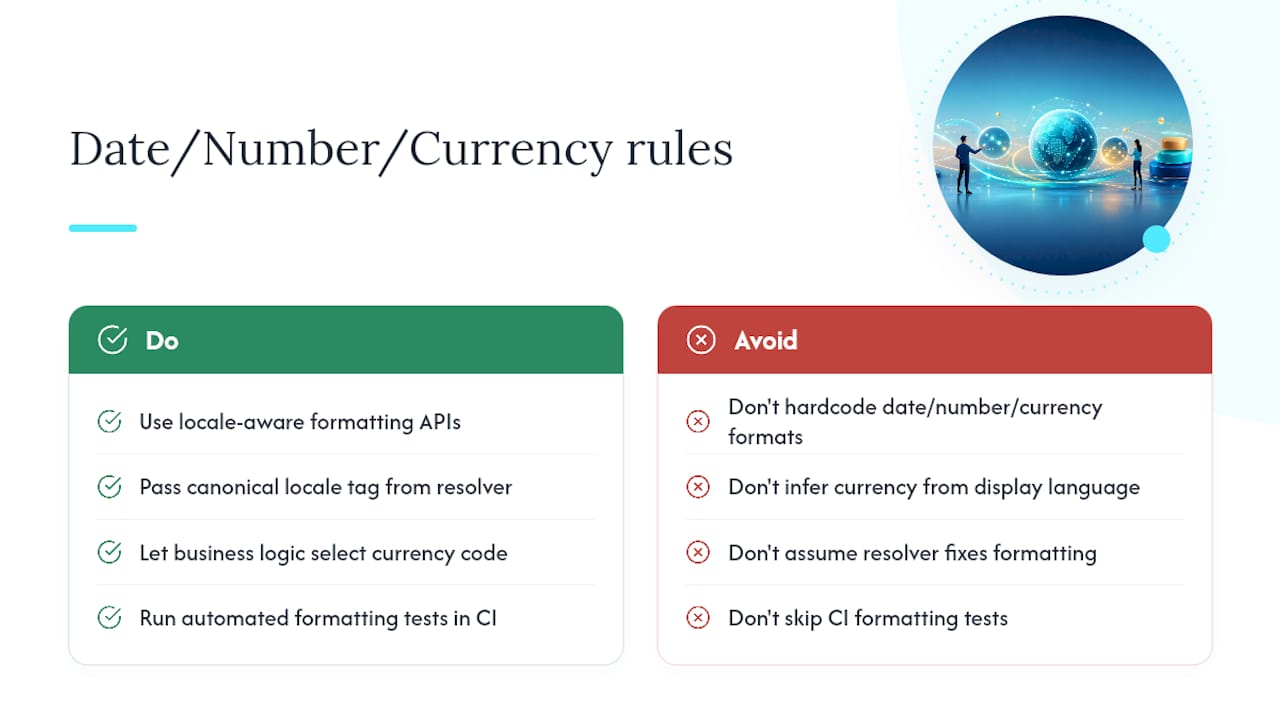
The practical rule: never hardcode a date, number, or currency format string. Use your platform’s locale-aware formatting APIs (Intl.DateTimeFormat, Intl.NumberFormat in JavaScript, or their equivalents on mobile) and feed them the canonicalized locale tag from your resolver, not a hardcoded default. This keeps formatting and content negotiation in sync automatically. When a user’s tag resolves to en-GB, dates should render as day-month-year without a separate formatting decision anywhere in your codebase.
Currency is the sharpest edge case. Formatting a number as currency and knowing which currency to display are separate decisions. Intl.NumberFormat will happily format 1234.56 as "1.234,56 €" for a German locale, but the currency code itself needs to come from your business logic, usually tied to the user’s region or account settings, not inferred from their display language. A French-speaking user shopping from a Canadian account should see Canadian dollars, not euros, regardless of which language bundle they are reading.
Test these formatting paths the same way you test the resolver: automated checks that render sample dates, numbers, and currency amounts for every supported locale, run in CI, before release.
What Happens When a Language Isn’t Supported
Every resolver eventually gets a request for a language you have not built. A browser sends Accept-Language: cy for Welsh, or geo-IP flags a visitor from a country with a language you have not localized yet. The failure mode you want is graceful degradation, not a blank screen or a raw translation key.
Your default bundle is the answer here, and it needs to actually be complete. If English is your default, every single string key used anywhere in the app needs an English value, with no exceptions carved out for “edge case” screens. A missing key in the default bundle is worse than a missing key in any regional bundle, because there is nowhere left to fall back to.
For languages you support partially, be explicit about it rather than letting users discover gaps mid-flow. Some teams ship a banner noting the UI is partially translated; others simply route unsupported base languages straight to the default without pretending a five-word bundle counts as localization. Neither approach is wrong, but silence is: a UI that mixes two languages mid-screen because half the keys resolved and half fell through looks broken even when the underlying logic is working as designed.
Rare regional variants deserve the same fallback-map treatment covered earlier. fr-CH should land on fr-FR or a dedicated fr-CH bundle, never on a coin-flip truncation to bare fr that happens to load whichever file your build system lists first.
Is Geo-IP and Cookie-Based Detection Safe to Use?
Geo-IP and cookies are both useful signals and both carry privacy weight that small teams sometimes underweight. Geo-IP resolution requires reading a user’s IP address against a location database, which counts as processing personal data under most privacy frameworks, even though it is used here for something as low-stakes as picking a language; for guidance on handling these issues, see how to streamline cross-border payments and fintech localization.
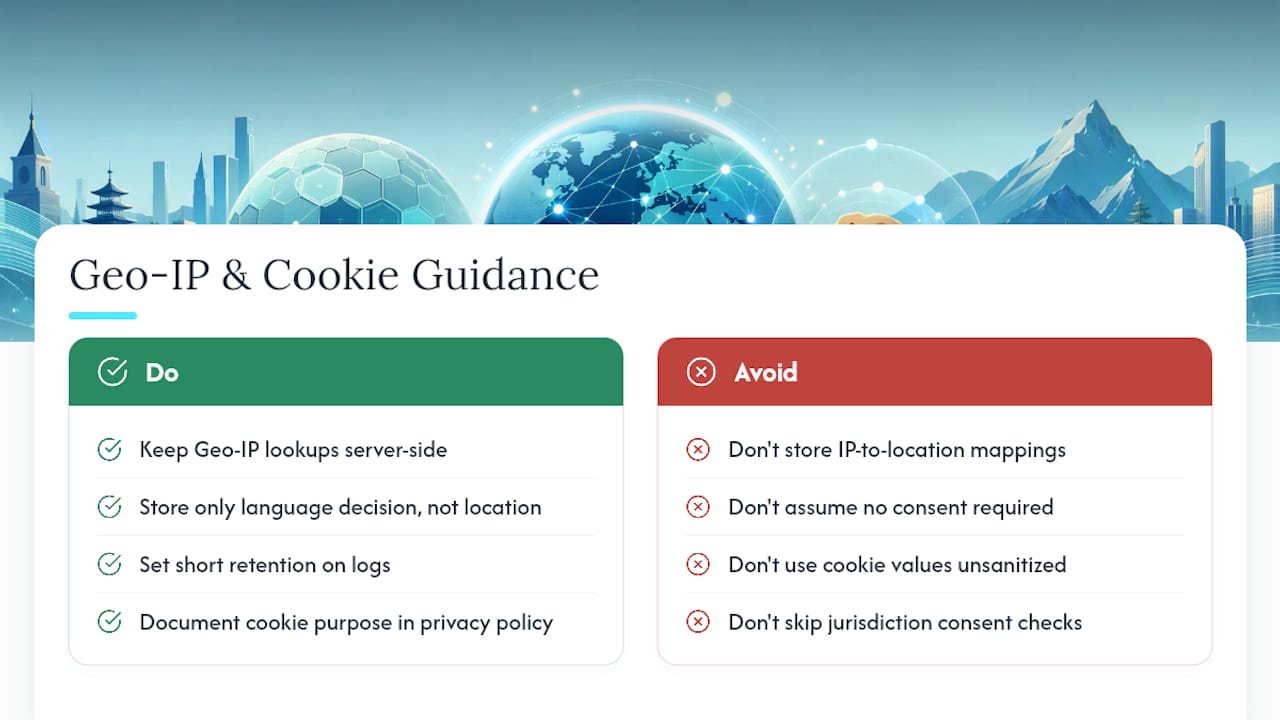
Keep geo-IP lookups server-side and ephemeral. There is rarely a good reason to store the resolved geographic location itself, only the resulting language decision. Log the language outcome for debugging if you need to, not the raw IP-to-location mapping, and set a short retention window on anything you do keep.
Cookies used for language preference are functional, not tracking, cookies in most consent frameworks, since they store a UI preference rather than behavioral data. That distinction matters for consent banners: a language-preference cookie generally does not need the same opt-in gate as an advertising cookie, but check this against your specific jurisdiction’s rules rather than assuming. Document the cookie’s purpose clearly in your privacy policy regardless, since regulators increasingly expect specificity over blanket “we use cookies” language.
The security angle is smaller but real: never let a language cookie value get used unsanitized in a file path or template lookup. A resolver that takes a cookie value and does loadBundle(cookieValue) without validating it against your actual supported-locale list is an injection risk waiting for a malformed or malicious cookie value.
Client-Side vs. Server-Side Rendering: Where Should Negotiation Live?
Server-side rendering gives you a clean advantage: you can resolve the locale before you send a single byte of HTML, so the user never sees a flash of the wrong language. The resolver reads headers, cookies, and the URL path on the server, picks a locale, and renders the correct bundle directly into the response.
Client-side rendering is messier by nature. The browser has to load a shell, run JavaScript, figure out the locale, then fetch or render the right bundle, which means there is almost always a brief window where either nothing is shown or the wrong language flashes before the correct one loads. Single-page apps that rely purely on client-side Accept-Language parsing are especially prone to this, since navigator.language reflects browser UI language, not necessarily the same value the server would have resolved from headers.
The practical fix for client-heavy stacks is to resolve on the server for the first response, even if the rest of the app is a client-rendered SPA, and pass that resolved locale down as an initial prop or embedded value the client-side app reads on boot. This is the same resolve-once-at-edge principle from the resolver discussion above, just applied to the render layer instead of the routing layer. Once the client has that initial value, it should treat it as authoritative and only re-resolve on an explicit user action, never re-run Accept-Language parsing on every route change.
Frameworks that support both rendering modes (server-rendered pages with client-side hydration) should share one resolver implementation between both paths. Two separate resolvers, one for server requests and one for client hydration, is how teams end up with a locale mismatch bug that only appears on the second page a user visits.
Keeping Multilingual Bundles Small Enough to Ship
Every language you add is a bundle you now have to load, cache, and maintain, and the naive approach of shipping every language to every user does not scale past three or four locales before load times suffer.
Code-splitting by locale is the standard fix: bundle each language’s strings separately and load only the resolved locale’s bundle at runtime, not the full set. This applies to voice assets too. If you are shipping TTS narration alongside text, loading all language audio files upfront is far worse for bundle size than loading text bundles, since audio files run orders of magnitude larger than JSON strings.
A few concrete moves keep this manageable:
- Split translation bundles by route or feature, not just by language, so a user only downloads strings for screens they actually visit.
- Lazy-load non-default locale bundles; ship the default language inline and fetch others on demand.
- Compress and cache voice assets aggressively, since they are the largest files in a typical multilingual package.
- Track bundle size per locale in CI and flag regressions, the same way you would track JavaScript bundle size.
Packaging structure matters as much as compression here. A well-organized language file packaging output, with a predictable folder structure per locale and platform, makes it far easier to lazy-load selectively instead of pulling in an entire monolithic translation file just to render one screen.
The Editorial Take: Stop Treating This as Academic i18n
Most i18n guidance reads like it was written for framework maintainers, not for the three-person team trying to ship a localized app update by Friday. That gap is where most implementations quietly fail. Teams read about RFC 4647 lookup and BCP 47 canonicalization, nod along, and then hand-roll a resolver that truncates Accept-Language and calls it done, because the academic version of this advice never connects to the packaging and release side of the job.
The conventional advice undersells two things: determinism and default-bundle completeness.
If you take one thing from this, prioritize getting a validated, complete default bundle and a deterministic resolver order working before you worry about supporting a twelfth language. Coverage breadth without a solid fallback foundation just multiplies the number of ways things can break quietly in production.
— Arkian
Ready to Package Your Next Multilingual Release?
A platform fits directly into the workflow this article just walked through: once your resolver knows which locale a user gets, it handles turning that into a validated, release-ready bundle without a TMS project or repository access standing between your code and your translations.
If you are working with app strings, start with localization strings for JSON, iOS, Android, and YAML, or go straight to locale-specific packaging output if you already know the folder structure your release pipeline expects. Teams shipping voice alongside text can run a sample job through Structured Multilingual TTS Production to see validated audio assets packaged the same way. Not sure Arkian fits your stack yet? Check who Arkian is built for and run a single test locale through the pipeline before committing a whole release to it.
Sources
- I18n-l10n
- Locale negotiation and LocaleService — Firefox source docs
- LLM-assisted localization widens identity UX complexity in web apps