
Developer First Localization Pipeline Orchestration with ICU and XLIFF
Developer First Localization Pipeline Orchestration with ICU and XLIFF

Localization pipeline orchestration is the practice of automating extraction, translation, validation, and packaging of locale assets as explicit CI/CD stages so multilingual releases ship with the same cadence and quality as the main product. Treating localization as code, with gates and checks instead of manual handoffs, prevents string drift between languages, keeps release velocity intact, and catches formatting errors before they reach production.
TL;DR:
- Automation should include validation gates to prevent broken strings and formatting errors from reaching production, especially when supporting multiple locales.
- Supporting multiple file formats like JSON, iOS strings, and Android XML from a single internal catalog simplifies multi-platform localization workflows.
- Running translation push steps in dry-run mode during pull requests helps reviewers verify changes before they are merged into the main branch.
- Versioning each language package with the application’s release number enables independent rollback of translation errors without affecting the entire app.
- Small teams can adopt platforms like Arkian that generate ready-to-review language files, reducing the need for maintaining full CI/CD pipelines and repository access.
Table of Contents
- Core components of a localization orchestration pipeline
- Pipeline design patterns: stages, gates, and execution models
- Message models and interchange formats
- CI/CD integrations and security best practices
- Validation, QA, and smoke-testing localized builds
- Orchestration patterns and practical implementation tips
- Practical example: how Arkian helps small teams automate delivery
- Metrics and KPIs to evaluate localization pipeline efficiency
- Handling and automating translation memory and glossary updates
- Versioning and rollback approaches for localization artifacts
- Supporting multiple platforms and file types in pipeline orchestration
- When to invest in orchestration and common organizational pitfalls
- Arkian: a practical, low-friction automation option for small teams
- Core standards and docs to consult
- Sources
- FAQ
Core components of a localization orchestration pipeline
A continuous localization pipeline automates five recurring stages, each solving a specific coordination problem between engineering and translation work.
- Extract: source strings get pulled into a canonical catalog with stable keys, so every downstream step references the same identifiers regardless of which file format ships to the app.
- Push: only changed keys sync to the translation system. Selective sync matters because resending the full catalog on every commit multiplies vendor costs and makes it harder to tell which strings actually need review.
- Translate and review: this stage carries metadata alongside the raw text, context notes, descriptions, character limits, so a translator working on a button label knows it cannot run past 20 characters.
- Pull: approved translations come back and get packaged into build artifacts, JSON, iOS strings, Android XML, or similar formats depending on the platform.
- Gate: before packaging completes, the build checks for completeness and syntax validity. A background check at this stage confirms every key has a translation and every ICU pattern parses correctly before the artifact ships.
Skipping the gate stage is the most common shortcut teams take, and it is the one that produces broken strings in production. A pipeline that extracts and pushes but never validates is just a faster way to ship the same errors.
Pipeline design patterns: stages, gates, and execution models
The shape of your pipeline depends on release frequency and how many locales you support. A few patterns show up repeatedly in working systems.
- Stage-based pipelines separate extract, translate, and package into discrete jobs with their own logs and retry logic. This costs more setup time but makes failures easy to isolate, which single monolithic scripts rarely allow.
- Single-step scripts are faster to write and fine for a handful of locales, but a failure midway through leaves no clear record of what succeeded.
- Matrix and parallel jobs run per-locale tasks concurrently. If you support 15 languages, running them as 15 parallel jobs instead of a sequential loop cuts wall-clock time substantially, a pattern well-supported by Azure Pipelines staged execution and parallel job primitives.
- Gates and manual approvals protect sensitive regional content, legal disclaimers or region-specific claims, from auto-publishing without human sign-off.
- Trusted-event separation determines which triggers can run mutation steps. Pull request checks should run in dry-run mode; only merges to a protected branch should push live translations or commit generated files, a distinction demonstrated in one example localization pipeline that creates reviewable pull requests rather than committing directly.
Pro Tip: Run your translation push step in dry-run mode on every pull request so reviewers see a diff of what will change before anything touches the main branch.
Message models and interchange formats
Message syntax is an API contract, not decorative text. Breaking a plural or select pattern into concatenated string fragments destroys the grammatical structure a translator needs to produce correct output in languages with different pluralization rules.
- Use Unicode MessageFormat for any string involving plurals, gendered selects, or variable arguments, since ICU patterns and skeletons keep number and date formatting locale-independent rather than hardcoded.
- Never strip translator-facing metadata, context notes, character limits, screenshots, when converting between formats. That metadata is what prevents a translator from guessing wrong.
- When multiple vendors or tools need a lossless handoff, generate XLIFF 2.2 files from your canonical source rather than hand-editing them. XLIFF 2.2 carries translation state, references, and placeholder structures that make merges automatable instead of manual.
- Avoid fragment concatenation ("Welcome, " + name + “!”) in favor of whole-message templates; concatenation breaks word order in languages that do not share English syntax.
CI/CD integrations and security best practices
Localization jobs that mutate repositories or publish artifacts deserve the same security posture as deployment jobs, because a compromised translation credential can push arbitrary content into a production build.
- Run extraction, validation, and packaging steps on trusted runners or containers, and isolate any step that writes to a repository or publishes a package from untrusted events like pull requests from forks.
- Store translation-service credentials as encrypted secrets or use short-lived OIDC tokens rather than long-lived API keys, following least-privilege scoping for every job.
- GitHub Actions documentation specifies that forked-repository workflows do not receive repository secrets by default, a boundary that exists specifically to prevent secret exfiltration through untrusted pull requests.
- Use staged execution, parallelism, and observable job outputs so a failed translation push surfaces in logs immediately instead of silently corrupting the next step.
Pipeline reliability depends on the same controls used for deployment: Azure DevOps Pipelines documents staged execution, parallel jobs, approvals, and deployment targets as the core primitives for making any automated workflow, localization included, repeatable and observable.
Validation, QA, and smoke-testing localized builds
Before a localized build merges or ships, automation should run a specific set of checks rather than trusting that translation vendors returned clean data.
- Completeness check: confirm every key in the canonical catalog has a corresponding translation and that no string is stuck in a draft or unreviewed state.
- Syntax validation: parse every ICU message pattern and confirm placeholders and HTML tags match between source and target, catching broken plurals before they reach a device.
- Length and constraint checks: flag translations that exceed character limits set for buttons, labels, or fixed-width UI elements.
- Pseudo-localization and visual smoke tests: compile each locale and render critical screens to catch truncation, overlapping text, or right-to-left layout issues.
- Diagnostic output: when a check fails, log which source string failed and why, so a developer can triage the issue in minutes instead of rerunning the entire pipeline.
Orchestration patterns and practical implementation tips
Day-to-day reliability comes down to a handful of operational habits more than any single tool choice.
- Use change-detection so only keys modified since the last successful run get translated, cutting both vendor cost and pipeline latency.
- Have automation open a reviewable pull request for translators and engineering reviewers instead of committing directly to a release branch, matching the pattern used in example localization pipeline implementations that favor PRs and dry-run checks over direct commits.
- Retain logs and per-locale compiled outputs as build artifacts so a regression can be traced back to the exact run that introduced it.
- Build in retry and backoff logic for external translation API calls, with a fallback to the last known-good translation rather than failing the entire build over one timeout.
Pro Tip: Cache the last successful translation response per key so a transient API failure falls back to existing text instead of blocking the whole release.
Practical example: how Arkian helps small teams automate delivery
Some platforms automate multilingual scripts, text-to-speech output, and structured language packages without requiring repository access or a full translation management system, a design choice for teams without dedicated localization engineering functions.
This approach reduces friction in two concrete ways: validation and packaging happen inside the platform, so teams receive structured, ready-to-review language files in JSON, iOS, Android, or YAML format rather than raw translation output they have to reformat themselves. Arkian’s case study with the Quiet Harbour app illustrates this packaged delivery model in practice.
When evaluating any tool for small-team orchestration, check three things: which packaging formats it produces, whether it requires repository access, and whether review happens before or after delivery.
Metrics and KPIs to evaluate localization pipeline efficiency
Measuring a localization pipeline means tracking operational health, not just translation volume. A handful of metrics reveal most problems early.
Translation turnaround time tracks how long a changed key takes to go from push to approved pull back into the catalog. A rising trend usually signals vendor capacity issues or a review bottleneck, not a pipeline defect.
Pipeline failure rate measures how often the gate stage rejects a build for missing keys, broken ICU syntax, or placeholder mismatches. A high rate early in adoption is normal; a rate that stays flat after a few months suggests the validation rules need tuning or the source team needs better string hygiene.
Key churn counts how many strings change per release cycle. High churn drives up translation cost and signals that UI copy is being finalized too late in the development cycle rather than locked before localization begins.
Locale coverage tracks what percentage of the catalog has approved, non-draft translations per language. This number matters most right before a release gate, where incomplete coverage should block packaging rather than ship partial translations silently.
Time to detect a regression measures how long a broken string or layout issue sits in production before someone notices. Pseudo-localization and visual smoke tests in the pipeline should catch most of these before release, pushing this number toward zero.
None of these metrics matter in isolation. A team with fast turnaround but high failure rates is masking a validation problem with speed, and a team with perfect coverage but slow turnaround is bottlenecking releases on translation rather than code.

Handling and automating translation memory and glossary updates
Translation memory and glossaries drift out of sync with the codebase just as easily as the strings themselves do, and most teams only notice when a translator flags an inconsistent term.
The fix is treating both as versioned assets with their own update path inside the pipeline, not as static files uploaded once and forgotten. When a glossary term changes, example: a product name shifts from “Settings” to “Preferences”, the pipeline should flag every existing translation that used the old term so reviewers can decide whether to bulk-update or leave historical strings alone.
Translation memory should update automatically as approved translations flow back through the pull stage, feeding future matches without requiring a separate manual export and import cycle. This keeps terminology consistent across releases without turning glossary maintenance into its own project.
A practical pattern: store the glossary and translation memory alongside the canonical string catalog, version them together, and run a diff check as part of the push stage so any glossary change surfaces before new translations go out using outdated terms. Teams running a full TMS can automate this natively, while smaller teams without one often manage glossary consistency manually or through a platform that bundles memory updates into its packaging step, as Arkian’s metadata production does for small teams that cannot justify a dedicated TMS.
Versioning and rollback approaches for localization artifacts
Localization artifacts need version control just as much as application code, because a bad translation push can break a build in ways that are hard to spot until a specific locale is tested.
Tag every packaged language file bundle with the same version or build number as the application release it ships with. This makes it possible to roll back a locale bundle independently of the application code if a translation error surfaces after release, without forcing a full application rollback.
Keep historical packaged artifacts, not just the source catalog, as retained build outputs. If a regression appears in the French build three releases later, having the exact packaged file from each prior release makes it possible to bisect which release introduced the problem rather than guessing from commit history alone.
Rollback should target the packaging stage specifically: revert to the last known-good compiled language file rather than attempting to re-run the entire translation pipeline under pressure during an incident. Re-running translation live during a rollback introduces new risk at the worst possible time.
Supporting multiple platforms and file types in pipeline orchestration
A pipeline that only handles one file format works until the product ships a second platform, at which point format fragmentation becomes the main source of pipeline complexity.
Mobile apps typically need iOS .strings and Android XML, web apps need JSON or YAML, and some teams maintain TypeScript-typed string catalogs for compile-time safety. Each format has different escaping rules, different placeholder syntax, and different limits on nesting, which means a single extraction and validation layer needs format-specific adapters rather than one generic parser.
The canonical catalog should remain format-agnostic internally, with conversion to each target format happening only at the packaging stage. This keeps the translation and validation logic identical across platforms while letting each platform’s build consume the format it expects natively. Arkian’s approach to this problem is to generate each target format, JSON, iOS, Android XML, YAML, from the same underlying production job, so a small team supporting both a mobile app and a web client does not need separate pipelines for each.

Audio assets add another dimension entirely: a pipeline that produces multilingual voice output alongside text strings needs its own packaging and versioning path, since audio files do not diff or merge the way text does.
When to invest in orchestration and common organizational pitfalls
Continuous localization earns its complexity when release cadence is fast and locale count is high enough that manual handoffs become the bottleneck. A team shipping quarterly in three languages rarely needs staged CI gates. A team shipping weekly in fifteen does.
The real failure mode is not choosing the wrong pattern, it is skipping the ownership contract: who approves a translation, who owns the glossary, who gets paged when a gate fails. Teams that skip this end up with lost context metadata, secrets pasted into workflow files instead of stored properly, or pipelines so elaborate that a two-person team spends more time maintaining YAML than shipping features.
— Arkian
Arkian: a practical, low-friction automation option for small teams
For teams that do not want to build and maintain a full CI/CD localization pipeline, Certain platforms offer automated production of multilingual strings, voice output, and structured metadata, delivered as validated, ready-to-review language files without requiring repository access or a TMS.
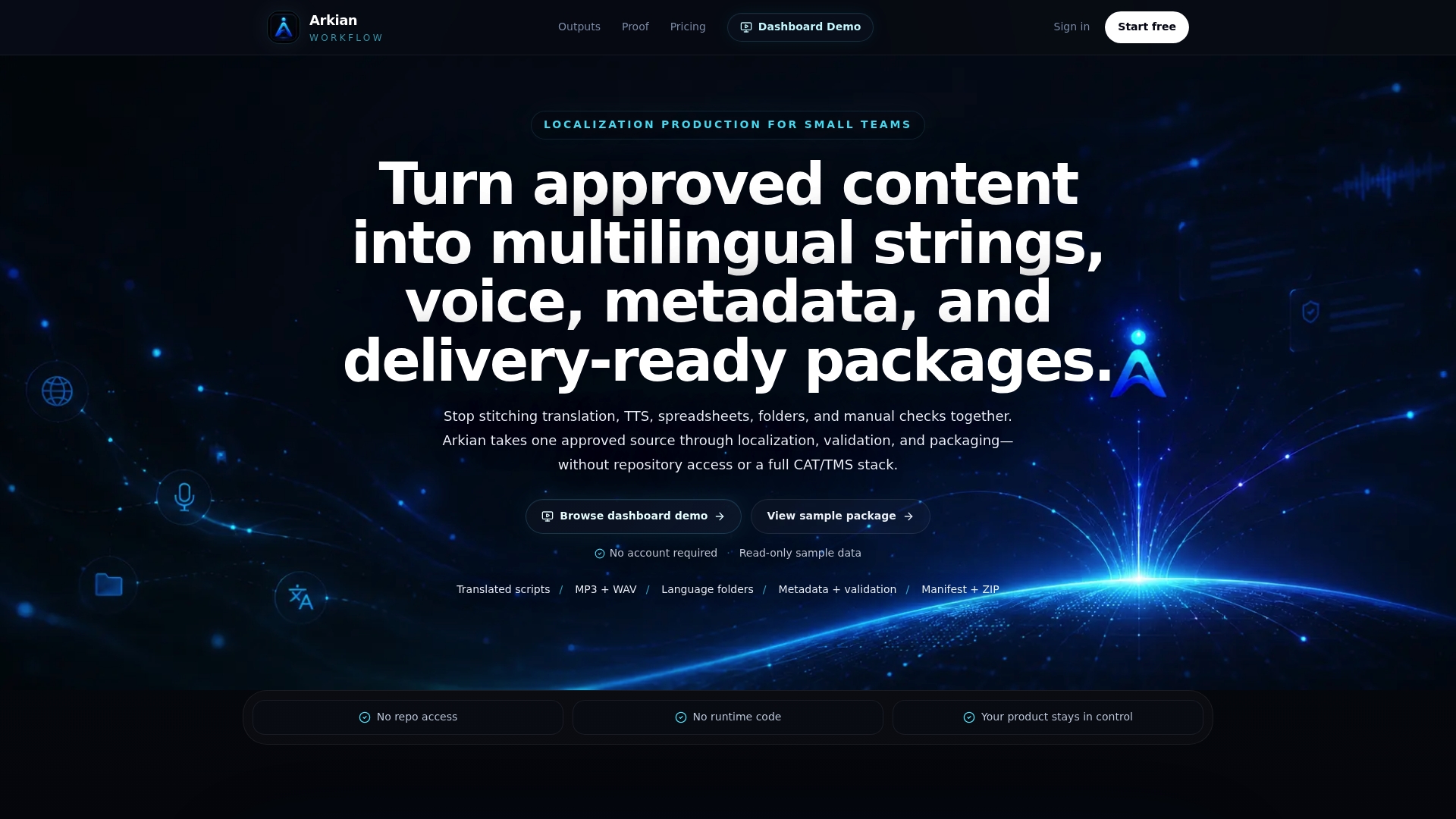
Compared to building staged pipelines from scratch, Arkian’s packaging step produces JSON, iOS, Android, and YAML files directly. This way a small team gets delivery-ready artifacts without wiring up extraction, gates, and format conversion themselves. Review the pricing page to see current plans, including the Arkian Membership with a monthly plan, or the one-off Starter, Pro, and Studio product lines, and find the option that fits your team’s release volume.
Core standards and docs to consult
- Unicode TR35: MessageFormat for plural, select, and variable message syntax.
- XLIFF 2.2 Core specification for lossless translation interchange.
- Azure Pipelines documentation and GitHub Actions secrets guidance for CI/CD stages and secret handling. Teams scaling localization across multiple regional storefronts can also review Quick To Impress’s work with multi-location brands for staged release strategy.
Sources
- Unicode TR35: MessageFormat (Part 9)
- XLIFF Version 2.2, Part 1: Core
- GitHub Actions: Using secrets in workflows
- Example localization pipeline repo
FAQ
What is data pipeline orchestration?
Data pipeline orchestration is the coordination of multiple automated steps, extraction, transformation, validation, and delivery, so they run in a defined order with dependencies, retries, and monitoring handled automatically. In localization, this means treating string extraction, translation, and packaging as linked CI/CD stages rather than separate manual tasks.
What are the best tools for localization?
The right tool depends on team size and workflow: large organizations often run a full translation management system integrated with CI/CD, while small teams without repository access or TMS budgets benefit from platforms that automate extraction, validation, and packaging in one step, such as Arkian’s localization strings service. Standards like Unicode MessageFormat and XLIFF 2.2 matter more than any single vendor since they keep output portable between tools.
What is a localization workflow?
A localization workflow is the sequence of steps that take source content from development through translation and back into a shippable build: extraction, translation and review, and packaging into the target file formats. A continuous localization workflow automates this sequence inside CI/CD with explicit gates instead of manual file handoffs.
How do I validate a localization pipeline before release?
Validation should check for missing translation keys, broken ICU message syntax, mismatched placeholders, and length overruns, then compile each locale and run pseudo-localization or visual smoke tests on critical screens. Automated diagnostic output that names the failing source string speeds up triage considerably.
What file formats does an automated localization pipeline need to support?
Most pipelines need to support JSON and YAML for web, iOS .strings for Apple platforms, and Android XML for Android, often alongside TypeScript-typed catalogs for compile-time safety. Platforms like Arkian’s structured packaging generate multiple formats from a single production job to avoid maintaining separate pipelines per platform.