
Cut Dev Time: 7 Steps to Localize a Privacy Policy for Small Teams
Cut Dev Time: 7 Steps to Localize a Privacy Policy for Small Teams

Localizing a privacy policy means translating and adapting one master document into each target language while preserving its legal meaning, then publishing it as a synchronized, locale-specific version. The right approach is to keep a single modular source, externalize every translatable string, run a coordinated translation and QA pass, and package the result for each locale. Regulations like GDPR Article 12 and CCPA/CPRA guidance both push toward the same standard: clear, plain language in the reader’s own tongue.
TL;DR:
- Prioritize translating privacy policies based on user volume and regulatory risk, rather than supporting every language from the start.
- Develop a modular, plain-language master document with clearly labeled sections, metadata, and consistent naming across languages to simplify updates.
- Externalize all user-facing strings, use proper placeholders, and provide context notes to prevent translation errors and maintain clarity across languages.
- Match translation methods to market risk, combining machine, human, or hybrid approaches, with translation memory and glossaries to ensure consistency.
- Automate localization workflows with change detection and synchronized delivery systems to keep translations current and streamline legal sign-off.
Table of Contents
- Your Privacy Policy Localization Checklist
- How Do You Build a Master Policy That’s Easy to Translate?
- What Does Technical Readiness Actually Require?
- Machine, Human, or Hybrid: Which Translation Method Fits?
- How Do You Keep QA and Legal Sign-Off in Sync?
- What Makes a Localized Policy Actually Publishable?
- What Small Teams Get Wrong About Localizing Privacy Policies
- Get Localized Privacy Policy Files Without the Repo Access
- Sources
Your Privacy Policy Localization Checklist
Before you touch a translation tool, get the sequence right. Skipping steps here is what causes half-finished locales and legal headaches six months later.
- Rank languages by site analytics and regulatory exposure, not by guesswork.
- Write a modular master source in plain language, split into labeled sections.
- Externalize every string and attach localization notes for translators.
- Pick a translation method (machine, human, or hybrid) and lock in a glossary.
- Run in-context review, then route each locale through legal sign-off.
- Publish with a visible language selector, hreflang tags, and update timestamps.
- Set up automated detection so a source edit triggers retranslation of only the affected sections.
Legal translators and localization vendors consistently recommend prioritizing by user volume and regulatory risk rather than translating every supported language on day one. That single decision saves small teams weeks of unnecessary work.
How Do You Build a Master Policy That’s Easy to Translate?
Your source document is the foundation everything else depends on, so treat it like a product, not a legal PDF someone wrote once and forgot about.
Write in plain language with short sentences. Legal teams tend to draft dense, clause-stacked paragraphs, but dense English produces ambiguous translations. A sentence with three embedded clauses gives a translator three chances to guess wrong about what modifies what.
Structure the policy into clearly labeled modules instead of one long scroll:
- Cookies and tracking technologies
- Data collection purposes
- User rights and how to exercise them
- Retention periods
- Contact information for privacy inquiries
Each module should carry its own metadata and changelog entry, and every localized page should display when that specific section was last updated. This matters more than it sounds: multilingual privacy policies build user trust precisely because readers can see the document is maintained, not abandoned after launch.
Keep jurisdiction-specific clauses in their own modules too. When a single country’s regulator demands a wording tweak, you want to edit one block, not rewrite the whole policy in twelve languages.
Pro Tip: Name your modules the same way across every language file (e.g., “cookies_v3”, “rights_v3”). It sounds trivial, but consistent naming is what lets automated tools match old and new versions during a retranslation pass.
What Does Technical Readiness Actually Require?
Legal text fails in translation for boring, fixable reasons: strings buried in code, placeholders with no context, or markup jammed inside a sentence a translator has to guess around.
Start by externalizing every user-facing string into a standard resource format like JSON, iOS .strings, Android XML, or YAML, and confirm everything runs on UTF-8 encoding so accented characters and non-Latin scripts render correctly.
From there, a few habits prevent most translation errors:
- Mark every placeholder and non-translatable term, and explain what runtime value fills it (a user’s name, a date, a company name).
- Never embed markup or raw URLs inside a translatable string. Use a placeholder with metadata instead.
- Add localization notes explaining ambiguous terms, tone, or intended audience.
- Attach screenshots or rendered previews so translators see the string in context, not as a floating fragment.
That last point is easy to skip and expensive to skip. A translator working from an isolated string like "Accept" has no way to know if it’s a button, a checkbox label, or a legal consent action. Context comments and visual previews resolve that ambiguity before it becomes a bug report.
Machine, Human, or Hybrid: Which Translation Method Fits?
Privacy text carries legal weight, so the method you choose should match the risk of the market, not just your budget.
Machine translation works fine for first drafts or low-risk markets where you’re testing demand before committing resources. It should never be the final published version of a legal document. Follow it with a human post-edit pass, every time.
For jurisdictions with strict language requirements, hire certified legal translators. Some EU member states, South Korea, and Vietnam enforce specific language and formatting expectations for consumer-facing legal notices, and a generic bilingual freelancer often misses those conventions.
Two governance pieces keep everything consistent as you scale past two or three languages:
- A translation memory ™ that stores previously approved sentences so recurring legal phrases don’t get retranslated differently each time.
- A firm glossary locking down core terms like “data controller,” “legal basis,” and “consent” so they translate the same way in every module and every language.
Define your reviewer passes clearly: a linguistic review first, checking grammar and tone, followed by a legal or regulatory sign-off confirming the translated meaning still matches the source obligation. Record each sign-off. If a regulator ever asks who approved the Portuguese version of your data retention clause, you want an answer in seconds, not an email search.
Pro Tip: Give your legal reviewer the English source and the translation side by side, not just the translated file. Reviewers catch far more drift when they can compare sentence by sentence instead of trusting a translator’s summary.
How Do You Keep QA and Legal Sign-Off in Sync?
Translation quality and legal accuracy are two different checks, and skipping either one creates real exposure. Run both, every release.
In-context visual review catches problems a text-only review misses entirely: truncated buttons, a German compound word that overflows its container, or a translated heading that no longer matches the section below it.
Automated quality gates catch the rest before a human even opens the file:
- TM match thresholds that flag segments diverging too far from previously approved language.
- Terminology checks confirming your glossary terms appear exactly as defined.
- AI-assisted quality scoring that surfaces likely errors for reviewer attention instead of making reviewers hunt blind.
Legal sign-off has to happen per locale, not once for the “master” version. Store each approval record with a timestamp and reviewer name. Centralized, synchronized translation management becomes essential once you’re maintaining more than a handful of languages, because manually tracking which locale is up to date turns into a spreadsheet nightmare fast.
The real efficiency gain comes from automating change detection. When the English master gets a new clause, the system should flag exactly which locales are now stale and queue only that section for retranslation, not the entire document.
What Makes a Localized Policy Actually Publishable?
A perfect translation buried three clicks deep with no way to find it does nothing for compliance or trust. Publishing mechanics matter as much as the translation itself.
- Put a visible language selector in the footer and link it from your cookie banner, since that’s often where users first look for privacy information.
- Add hreflang tags and correct canonical tags on any publicly indexed policy pages so search engines serve the right language version to the right audience.
- Display “last updated” and a version identifier on every localized page, and include a local data protection contact where regulations require one.
- Confirm every language version is mobile-friendly, works with screen readers, and reads at a plain, accessible grade level, not a legal-brief one.
A bilingual or multilingual web presence also does double duty for discoverability, giving international users a reason to trust the rest of your site along with the policy itself.
What Small Teams Get Wrong About Localizing Privacy Policies
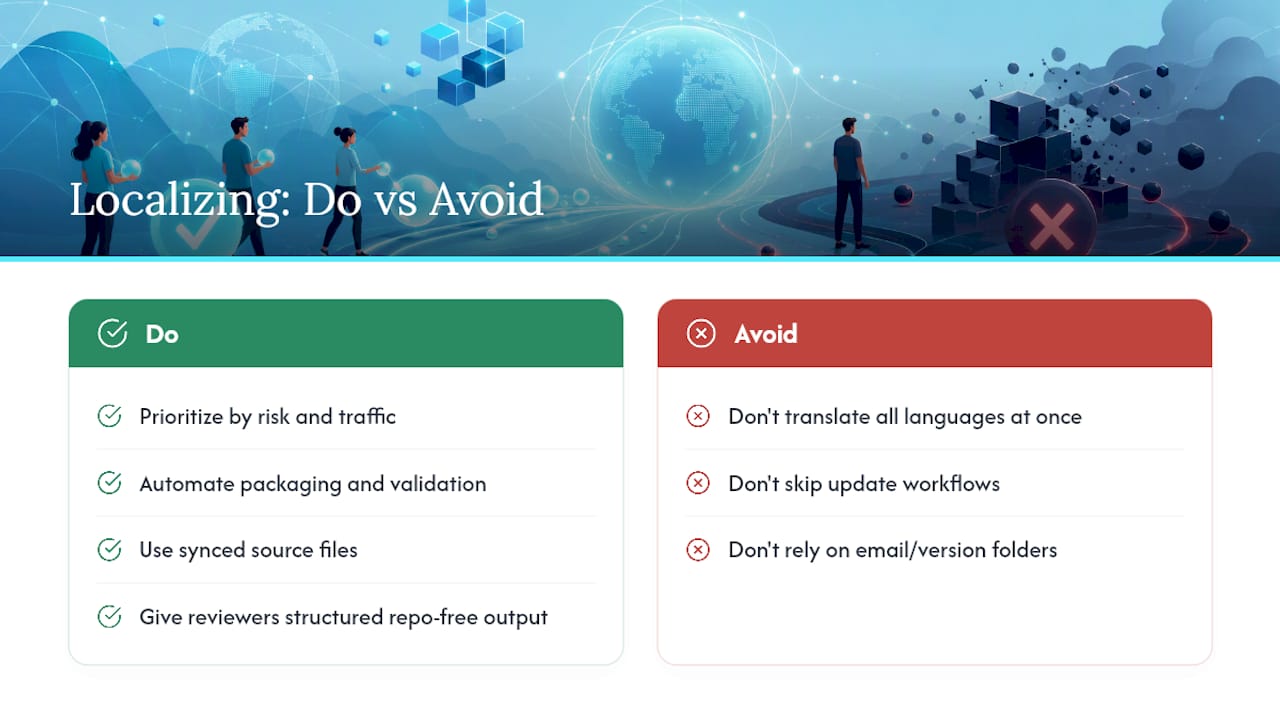
Most teams over-invest in translating everything at once and under-invest in the workflow that keeps translations current. That’s backwards. A privacy policy translated into nine languages and updated in only one of them is arguably worse than a policy available in three languages that all stay current.
Prioritize by regulatory risk and traffic, not by which languages sound impressive on a landing page. Automate the packaging and validation steps wherever you can. Every hour a developer spends manually formatting a translated JSON file is an hour not spent on the product. Keep translators, reviewers, and legal approvers working from the same synchronized files instead of email threads and version-numbered folders, and give reviewers structured output they can check without needing repository access at all. That last change alone tends to cut review turnaround from days to hours.
— Arkian
Get Localized Privacy Policy Files Without the Repo Access
Arkian automates the part small teams dread most: turning an approved master policy into review-ready language files for every locale you support, delivered as JSON, iOS .strings, Android XML, or YAML, without requiring reviewers to touch your codebase.
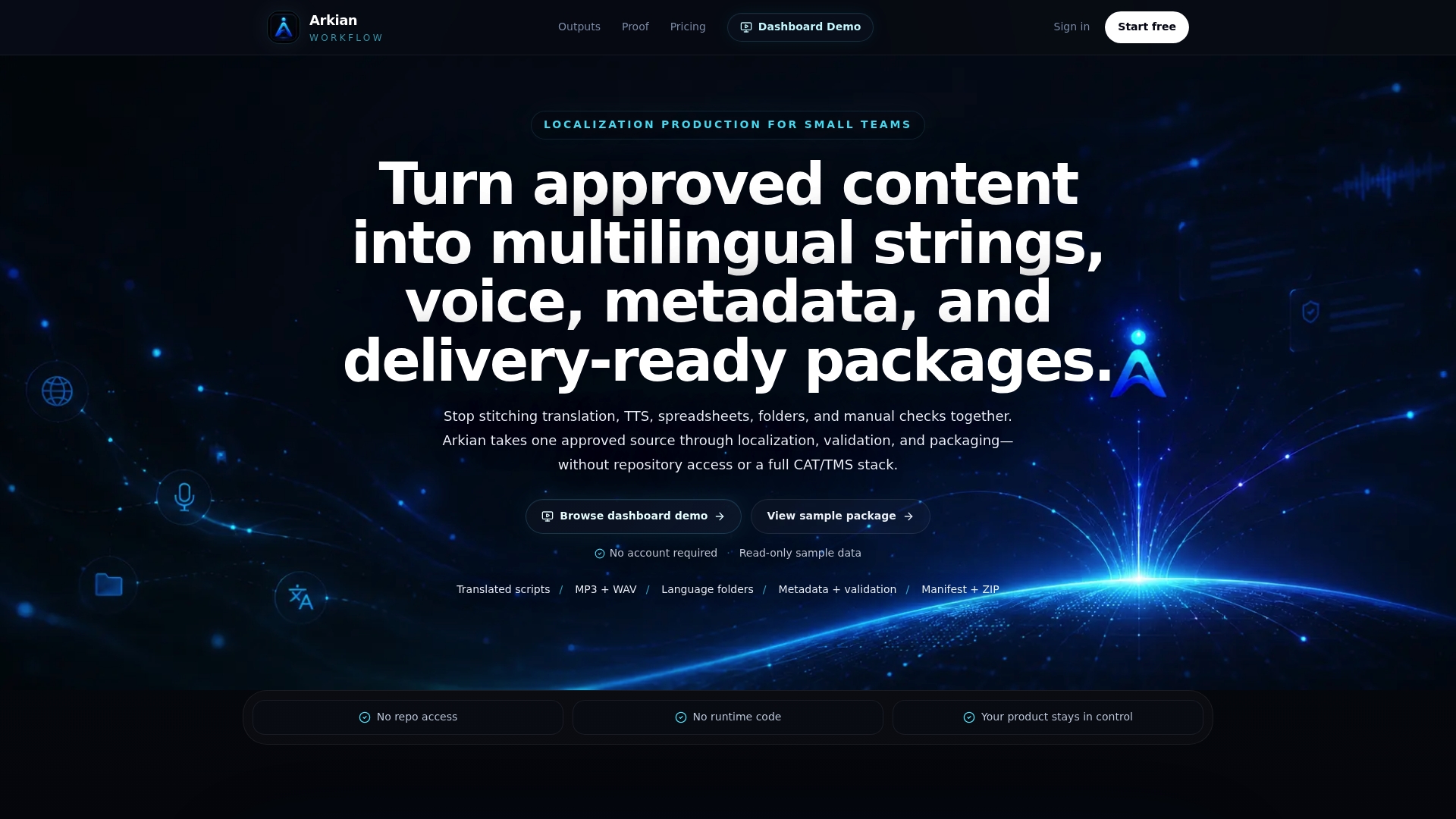
Instead of juggling translation vendors, a separate QA step, and a manual packaging process, Arkian runs extraction, validation, and packaging as one coordinated pipeline, so legal feedback and linguist edits land in a single delivery-ready bundle your developers can drop straight into a release. The Quiet Harbour implementation shows what that looks like in practice: a coherent, multilingual product experience built without a heavyweight translation management system. If your team is preparing a privacy policy release across several languages, see who Arkian is built for and get your first language package started.
Sources
- Localization best practices — Mozilla
- Privacy policy translation and compliance guide — Translated
- Multilingual privacy policies: what they are and why they matter — CookieYes