
6 Quick Wins to Speed Up Localization for Managers of Small Teams
6 Quick Wins to Speed Up Localization for Managers of Small Teams

The fastest, lowest-risk way to speed up localization is to automate routine file and handoff work, apply content tiering, and lock high-confidence machine translation segments. Together these levers can cut turnaround time by nearly 80% in small teams replacing spreadsheet handoffs with automated pipelines, while content tiering frees capacity for double-digit cost savings. One automation-first option is built for teams that want to pilot this fast.
TL;DR:
- Automating routine file handling and applying content tiering can reduce localization turnaround time by nearly 80%, especially for small teams.
- Implementing a standardized intake form and automating file conversions can eliminate manual delays and improve workflow speed within days.
- Pairing automation with process changes like small-batch releases and centralized terminology reduces work complexity and enhances productivity.
- Using AI-powered quality estimation thresholds and pseudolocalization in CI pipelines can catch issues early and cut review time nearly in half.
- Tracking key KPIs such as time-to-first-release and segment locking rates helps maintain speed gains and guides targeted improvements.
Table of Contents
- Quick wins: 6 practical things you can implement this week
- Tools and tech to accelerate localization
- Workflow and team changes that compound automation gains
- QA and testing automation that doesn’t slow you down
- Measure success: KPIs and a minimal dashboard
- Practical Arkian example: packaging-first automation for small teams
- Author perspective: practical trade-offs and sequencing
- How Arkian helps: pilot, packaging, and pricing links
- FAQ
- Sources
Quick wins: 6 practical things you can implement this week
Small teams don’t need a tooling overhaul to move faster. Most delays come from manual handoffs and unclear routing, both fixable in days.
- Build a standardized intake form that captures content type, audience, deadline, and risk level before a job enters the queue.
- Apply content tiering: Tier 1 covers legal or safety-critical text requiring full human review, Tier 2 covers marketing copy with light post-editing, and Tier 3 covers low-risk internal content that can ship MT-first.
- Start locking high-confidence MT segments using quality estimation, and route a low-risk channel like blog drafts or internal comms straight through MT with no human touch.
- Automate file conversion and packaging so reviewers open ready-to-review language files instead of raw spreadsheets.
- Add a pseudolocalization job to your continuous integration pipeline to catch layout and encoding problems before translation even starts.
- Replace manual task assignment with simple routing rules and webhook notifications so nothing sits waiting for someone to notice it.
Pro Tip: Pilot content tiering on one content type for two weeks before rolling it out everywhere; it’s the fastest way to see where your risk assumptions were wrong.
Tools and tech to accelerate localization
The architecture behind your workflow matters more than any single tool. Spreadsheet handoffs force manual copy-paste between systems, and each handoff adds a delay and a chance for error. API-driven pipelines remove both: content moves automatically between your source system, your translation layer, and your delivery format.
- Choose a lightweight packaging platform over an enterprise translation management system when your team is small and your main bottleneck is file wrangling, not vendor management at scale.
- Set machine translation quality estimation thresholds so segments above a confidence score get locked and skipped, while lower-confidence segments route to a human reviewer automatically.
- Prioritize tools that output directly in the formats your developers already use, including JSON, iOS .strings, Android XML, YAML, and TypeScript, so reviewers get packaging-ready files instead of intermediate exports.
- Connect your content management system and build pipeline through webhooks so new content triggers translation automatically instead of waiting for someone to notice it.
- Favor integrations that pull from and push to your existing repository structure rather than ones that require a full migration to adopt.
Workflow and team changes that compound automation gains
Tooling alone only gets you part of the way. The teams that see the largest gains pair automation with process changes that reduce the volume and complexity of work hitting the pipeline in the first place.
- Design your intake form to capture risk and audience metadata so content routes to the right tier automatically instead of waiting for a human triage step.
- Move to small-batch releases on an agile cadence rather than large quarterly localization pushes, which reduces rework when source content changes mid-cycle.
- Define your post-editing scope explicitly, referencing ISO 18587 guidance to separate light post-editing from full post-editing so reviewers know which standard applies to each job.
- Reserve your human reviewers for high-impact, high-risk content and let lightweight, user-driven quality checks handle low-risk items.
- Centralize your glossary and terminology rules in one place so every vendor and MT engine applies the same terms instead of each handling it differently.
Teams that adopt an MT-first mindset and lock high-quality segments report productivity gains of 20% or more in post-editing, largely because reviewers stop re-checking segments that were already correct.
QA and testing automation that doesn’t slow you down
Speed only counts if quality holds, and the way to protect both is to automate the boring parts of quality assurance and reserve human judgment for what actually needs it. Pseudolocalization, run in your continuous integration pipeline rather than after translation, catches hardcoded strings, layout clipping, and bidirectional text issues before a translator ever sees the file.
A two-stage approach works well for automated linguistic QA: rule-based checks catch placeholders, encoding errors, and length violations first, and a language model validation pass catches the subtler issues that fixed rules miss.
| QA stage | What it catches | When it runs |
|---|---|---|
| Pseudolocalization | Hardcoded strings, layout overflow, bidi issues | In CI, before translation |
| Rule-based checks | Placeholders, encoding, length limits | Immediately post-translation |
| LLM validation | Context and fluency errors | After rule-based pass |
AI-assisted error annotation cuts review time nearly in half, dropping per-error-span review from about 71 seconds to 31 seconds, which means prefiltering high-confidence segments can reduce the human annotation budget by nearly 25% without changing how systems are ranked for quality.
Measure success: KPIs and a minimal dashboard
You can’t preserve a speed gain you aren’t tracking. Keep the dashboard small enough that someone actually looks at it every week.
- Track time-to-first-release in days, measured from content ready to content live.
- Track mean turnaround per asset by content type, since a single blended average hides where the bottlenecks actually are.
- Track the percentage of segments locked by quality estimation versus sent for human review.
- Track rework rate: how often a reviewer sends a segment back after it was marked complete.
- Tie at least one metric to a business outcome, like time-to-market for a feature release, so the dashboard answers a question stakeholders actually care about.
Set a baseline before you change anything, then set a short-term target (four to six weeks) rather than an open-ended goal, and put the dashboard somewhere visible instead of buried in a weekly report.
Practical Arkian example: packaging-first automation for small teams
One approach centers on automating the creation of multilingual scripts, voice output, and structured language packages, with validation and packaging built in so teams don’t need extensive repository access or a full translation management system. It supports multiple output formats including JSON, iOS .strings, Android XML, and TypeScript, which maps directly onto the packaging-ready workflow described above.
Arkian’s documented collaboration with the Quiet Harbour app shows how a small team can package a localized product experience across multiple languages in a coherent, reviewable format.
To run a similar pilot:
- Pick one high-volume content type, such as app strings or onboarding copy.
- Configure packaging and quality estimation settings for that content type alone.
- Run the pilot for two to four weeks and report against the one KPI you chose beforehand.
Author perspective: practical trade-offs and sequencing
Start with intake, tiering, and a small MT quality estimation pilot before touching your broader tooling. That order surfaces your real bottlenecks before you spend money solving the wrong one. Automation without governance creates new failure modes faster than it removes old ones, so measure every change against a real KPI instead of assuming it worked. If you’re unsure where to start, run a short pilot, read the number, then decide.
— Arkian
How Arkian helps: pilot, packaging, and pricing links
A solution turns the tactics above into something you can click and run: automated packaging, multi-format output, and lightweight validation that skips repository access and translation management system setup entirely. 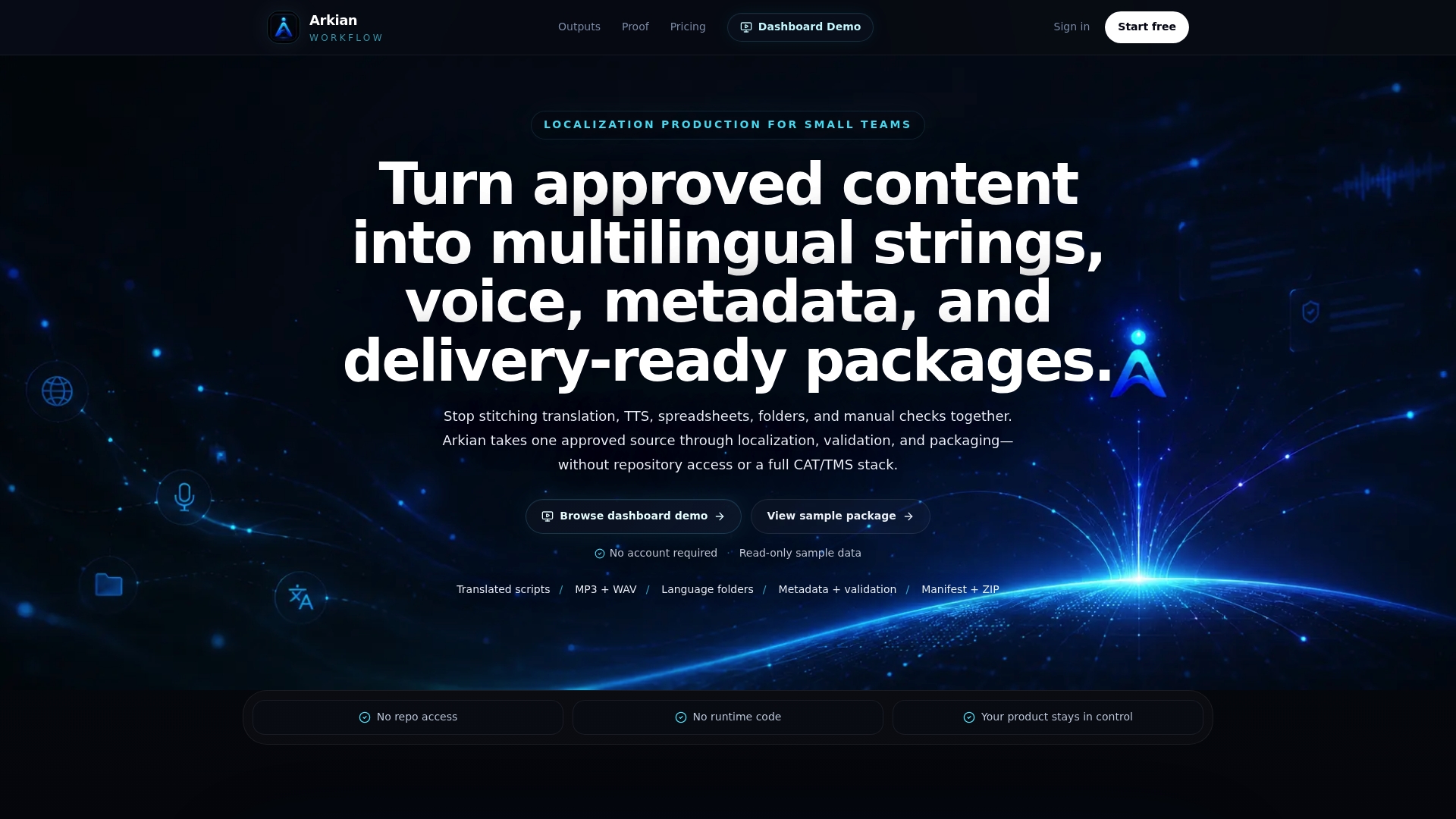
For a localization manager running a small team, that means a pilot you can configure in an afternoon instead of a procurement cycle. Review the Quiet Harbour case study for a concrete example, then check the Arkian membership and plan pricing, which starts at $19.00 CAD per month, to see which tier fits your content volume.

FAQ
Can AI do localization?
AI can handle large portions of localization, including translation, quality estimation, and even voice output, especially for lower-risk content tiers. Human review still matters for high-risk or brand-sensitive content, where light or full post-editing under ISO 18587 standards keeps quality in check.
Which translator is faster: human or machine?
Machine translation is faster for initial output, producing a full draft in seconds rather than hours or days. The real speed gain comes from pairing MT with quality estimation so only low-confidence segments need human post-editing, which is what drives the turnaround improvements of nearly 80% seen in automated pipelines.
What is an example of localization speed-up in practice?
A practical example is content tiering combined with MT-first routing: low-risk content like internal documentation or draft blog posts ships through machine translation with minimal review, while legal or safety content still gets full human post-editing. This approach has produced double-digit internal cost savings for teams that adopted it.
How does pseudolocalization speed up the QA process?
Pseudolocalization runs in the build pipeline before real translation happens, catching hardcoded strings and layout problems early using expansion factors of 30 to 60% for short strings and around 25% for longer text. Fixing these issues before translation is far cheaper than fixing them after, since no translated text needs to be redone.
What file formats should a small team’s localization tools support?
A small team’s toolchain should support the formats its developers already use, typically JSON, iOS .strings, Android XML, YAML, and TypeScript. Arkian packages output directly in these formats, which removes a manual conversion step that otherwise slows down every reviewer handoff.
Sources
- Toptal transforms localization efficiency with automated solutions – Case Study | Toptal®
- 7 Quick Improvements to Streamline Your Localization End-to-end
- AI-Assisted Human Evaluation of Machine Translation (NAACL 2025 long paper)
- I18n-l10n