
Small Teams: Ship Reviewer Ready App Strings Translation in One Sprint
Small Teams: Ship Reviewer Ready App Strings Translation in One Sprint

The fastest reliable way to handle app strings translation is to mark every user-facing string in code, extract those strings into structured resource files, run machine translation as a first draft, then have a human post-edit before packaging the final files for release. Skipping any one of those steps is where most small teams lose weeks. Formats like iOS .strings, Android XML, JSON, and YAML all support this pipeline, and platforms like Arkian now automate the extraction-to-package leg so teams without repository access can still ship reviewer-ready language files.
TL;DR:
- For small teams, using automated machine translation alongside IDE plugins provides the fastest workflow, especially when releasing weekly or more often.
- Marking user-facing strings with proper extraction markers and running automated extractors ensures accurate, up-to-date resource files for translation, reducing post-release bugs.
- Formats like JSON, iOS
.strings, and Android XML have specific requirements, with BCP 47 locale codes preventing orphaned or mismatched translations.- Google Play Console’s Gemini models enable continuous automatic translation, but safeguards like glossaries and placeholder checks are essential to prevent drift and errors.
- Running thorough preview steps, including pseudolocalization and RTL testing, helps detect UI issues caused by longer strings or different language directions before release.
Table of Contents
- What’s the Best Approach to App Strings Translation?
- How Do You Mark and Extract Strings for Translation?
- Which File Formats Work Best for Mobile App Translation Files?
- Can Machine Translation Handle App Strings Safely?
- How Do You Test and Preview Translated Strings Before Release?
- What Does a Weekly Localization Pipeline Look Like?
- Where Does Arkian Fit Into This Workflow?
- What Should Small Teams Prioritize First in Localization?
- Ready to Package Your App’s Translated Strings?
- Docs and Tools Worth Bookmarking
- Sources
- FAQ
What’s the Best Approach to App Strings Translation?
Four workflows dominate real-world app localization, and each fits a different team size and release rhythm.
Manual in-repo edits work fine for a two-language app updated twice a year. A developer opens strings.xml, adds a line, commits. Past three languages, this collapses. Nobody remembers which keys are missing in Portuguese, and reviews happen in pull requests nobody outside engineering can read.
IDE plugin workflows (like i18n-ally for VS Code) fix the visibility problem. You get inline annotations, hover previews, and one-click bulk translation for missing keys, all inside the editor a developer already uses. This is the sweet spot for teams shipping weekly without a dedicated localization hire.
Translation management systems (TMS) add glossary control, translation memory, and multi-reviewer approval chains. They’re built for teams managing a dozen languages and multiple content types, but the licensing and setup overhead rarely pays off for a five-person team shipping an MVP.
Automated Play Console and LLM-driven translation moves fastest. Google’s Play Console can continuously generate automatic app strings translations using Gemini models whenever you upload a new bundle, with a preview step before anything goes live.
Pick based on this checklist:
- Budget under $500/month for localization tooling: lean on IDE plugins plus automated MT.
- Releasing weekly or faster: automation beats manual edits every time; speed wins over polish on early drafts.
- Reviewer bandwidth is one bilingual teammate, not a team: automate the draft, spend human time only on post-edit.
- Regulated or safety-critical copy (legal disclaimers, medical guidance): require human review before publishing, no exceptions.
How Do You Mark and Extract Strings for Translation?
Reliable translation starts in the codebase, not in a spreadsheet. Every user-facing string needs a marker that separates it from logic so a tool can find it automatically.
- Wrap strings in a marker. Python and many web frameworks use
gettext’s_()convention; some JavaScript and mobile toolchains useL()or dedicated i18n tags. Marking translatable messages this way lets extraction tools build a message catalog automatically instead of someone hunting through files by hand. - Run an extractor. A lightweight tool like the
stringsutility scans your project for those marked literals and outputs an English resource file, often JSON or.strings, ready for translators to copy per locale. - Generate locale copies. Duplicate the base resource file for each target locale (
en.jsonbecomeses.json,pt-BR.json, and so on), keeping keys identical so nothing gets orphaned mid-translation. - Handle placeholders and plurals up front. Variables like
{name}or{count}need to survive translation exactly as written. ICU plural syntax ({count, plural, one {# item} other {# items}}) should be part of the base string before extraction, not patched in afterward. - Flag untranslatable values. Brand names, SKUs, and technical identifiers should never enter the translation queue in the first place.
Pro Tip: Run your extractor as a pre-commit hook, not a manual step someone remembers to do before a release. Missing keys caught at commit time cost minutes; missing keys caught in QA cost a delayed launch.
Which File Formats Work Best for Mobile App Translation Files?
Format choice depends entirely on platform, and getting it wrong means a rewrite later. iOS apps use .strings files, plain key-value pairs Xcode reads natively. Android apps use strings.xml, which supports plural rules and nested resource references but is fussier about escaping special characters. Cross-platform stacks (React Native, web apps, backend services) typically lean on JSON, YAML, or TypeScript resource modules, and formats like NestedText have gained traction specifically because they avoid quoting and escaping issues that trip up non-technical translators editing files directly.
Locale codes matter more than most teams realize. Stick to BCP 47 format (es-MX, not es_mexico or spanish), and mirror that naming in your folder structure. Android expects values-es-rMX; iOS and most JSON-based setups expect es-MX.json or a matching directory name.
A minimal delivery package should include:
- One resource file per locale, named consistently with its BCP 47 code.
- A manifest listing which locales shipped, a source checksum, and a validation report confirming no missing keys.
- Optional TTS audio assets if the app includes voice content, aligned to the same locale folders.
- A changelog noting which strings changed since the last package, so reviewers aren’t re-checking everything.
Arkian’s localization strings output follows this exact logic, exporting to JSON, iOS .strings, Android XML, TypeScript, or YAML depending on what your build pipeline expects, without requiring a TMS integration to get there.
Can Machine Translation Handle App Strings Safely?
Yes, with guardrails. Play Console’s automatic translation, powered by Gemini models, can continuously translate strings every time you upload a new bundle, and you can preview or edit the output before it goes live. That continuous behavior is the real win: instead of a one-time translation pass that goes stale after every feature update, new strings get draft translations automatically.
The risk is drift. Automatic translation can override existing human-edited strings if you’re not careful with settings, and MT engines don’t know your product’s terminology unless you tell them.
Three safeguards prevent most of the damage:
- Maintain a non-translatable list. Product names, legal entity names, and API-facing labels should be locked out of MT entirely, the same way you’d mark them untranslatable in Android’s Translations Editor.
- Build a glossary before you scale languages. Even a simple term list (your product’s core nouns, feature names, tone words to avoid) keeps five languages consistent instead of drifting apart independently.
- Run automated placeholder checks post-translation. Confirm
{name},{count}, and similar tokens survived translation untouched, and that plural forms still resolve correctly for each locale’s grammar rules.
For small teams, the time saved by automated packaging and validated exports often outweighs the complexity of integrating a full TMS, particularly when the output arrives as a reviewer-ready bundle rather than a pile of raw MT text needing manual reformatting.
How Do You Test and Preview Translated Strings Before Release?
Catching a translation bug in QA costs minutes. Catching it after users report a truncated button label in Japanese costs a hotfix release. A few tools make the difference.
- Use the Android Translations Editor. It consolidates every locale’s strings side-by-side against the default language, so you can spot missing or duplicate keys at a glance without opening five separate XML files.
- Preview inside Play Console before publishing. The draft bundle preview shows how Gemini-generated translations render in context, which catches obvious mismatches before real users see them.
- Run pseudolocalization. Generating a fake locale with elongated, accented text (a common QA technique) reveals UI elements that will truncate or overflow once real German or Finnish strings, which run longer than English, get dropped in.
- Test right-to-left layouts explicitly. Arabic and Hebrew don’t just flip text direction; they can break icon alignment and padding that nobody notices testing only left-to-right locales.
- Verify placeholders and plural rules on real devices, not just in the resource file. A plural rule that looks correct in JSON can still render oddly on a specific OS version.
Pro Tip: Take screenshots of every changed screen in every locale before handing a build to reviewers. It turns a “does this look right?” conversation into a five-minute yes/no scan instead of a full re-test.
What Does a Weekly Localization Pipeline Look Like?
A small team can have this running inside a single sprint. Here’s the sequence:
- Mark new strings with your chosen i18n convention as you write code, not after the feature is done.
- Extract on commit. A pre-commit or CI hook runs the extractor and generates an updated base resource file automatically.
- Auto-translate missing locales. Either Play Console’s Gemini-based translation or an editor plugin’s bulk-translate feature fills in draft text for every locale missing a key.
- Route drafts to a human post-editor. One bilingual reviewer per language, spending 15 to 30 minutes per release cycle, catches tone and terminology issues MT misses.
- Validate automatically. A CI job checks for missing placeholders, broken ICU plural syntax, and correctly named locale folders before anything merges.
- Package and stage. Build a staging release with the updated language files and generate reviewer screenshots per locale.
- Release. Ship the bundle, and let continuous automatic translation catch the next cycle’s new strings without repeating the setup.
Running extraction on every pre-merge commit and validating locale folder naming in that same CI job catches most structural errors before a human ever opens the file. A minimum viable pilot needs one developer to own extraction and CI hooks, one bilingual reviewer for post-edit, and roughly a half day of setup time. After that, the recurring cost per release is closer to an hour than a day.
Where Does Arkian Fit Into This Workflow?
Arkian automates the leg most teams struggle with most: turning marked, extracted strings into validated, delivery-ready packages without needing repository access or a TMS. The platform generates structured multilingual language files across JSON, iOS .strings, Android XML, TypeScript, and YAML, and it can pair that with TTS audio production when an app includes voice content.

Arkian’s collaboration with the Quiet Harbour app is a working example of this: coherent localized output delivered across multiple languages as a packaged, reviewer-ready set rather than scattered files needing manual assembly.
Arkian tends to fit best when:
- Your team lacks repository access for translators or contractors.
- You need packaged, validated files rather than raw translated text dumped into a spreadsheet.
- Releases happen fast enough that a full TMS setup would slow you down more than it helps.
What Should Small Teams Prioritize First in Localization?
Start with extraction and a single pilot locale before attempting five languages at once. Build a non-translatable glossary early. It’s the cheapest insurance against a brand name getting mangled in translation. Automate packaging and preview as soon as the pilot locale is stable, not after you’ve scaled to ten languages and the manual process is already breaking.
Success looks like shorter review cycles and fewer post-release bug reports about broken UI strings, not a longer list of supported languages. Teams chase language count first and pay for it in QA debt later. The right sequence is depth on one locale, then breadth once the pipeline proves itself.
— Arkian
Ready to Package Your App’s Translated Strings?
Arkian replaces the manual assembly work most small teams dread: hand-formatting locale files, chasing down missing placeholders, and rebuilding a translation memory from scratch every release. Instead, the platform automates multilingual language file production and validation, delivering packages developers can drop straight into a build without repository access or TMS setup.
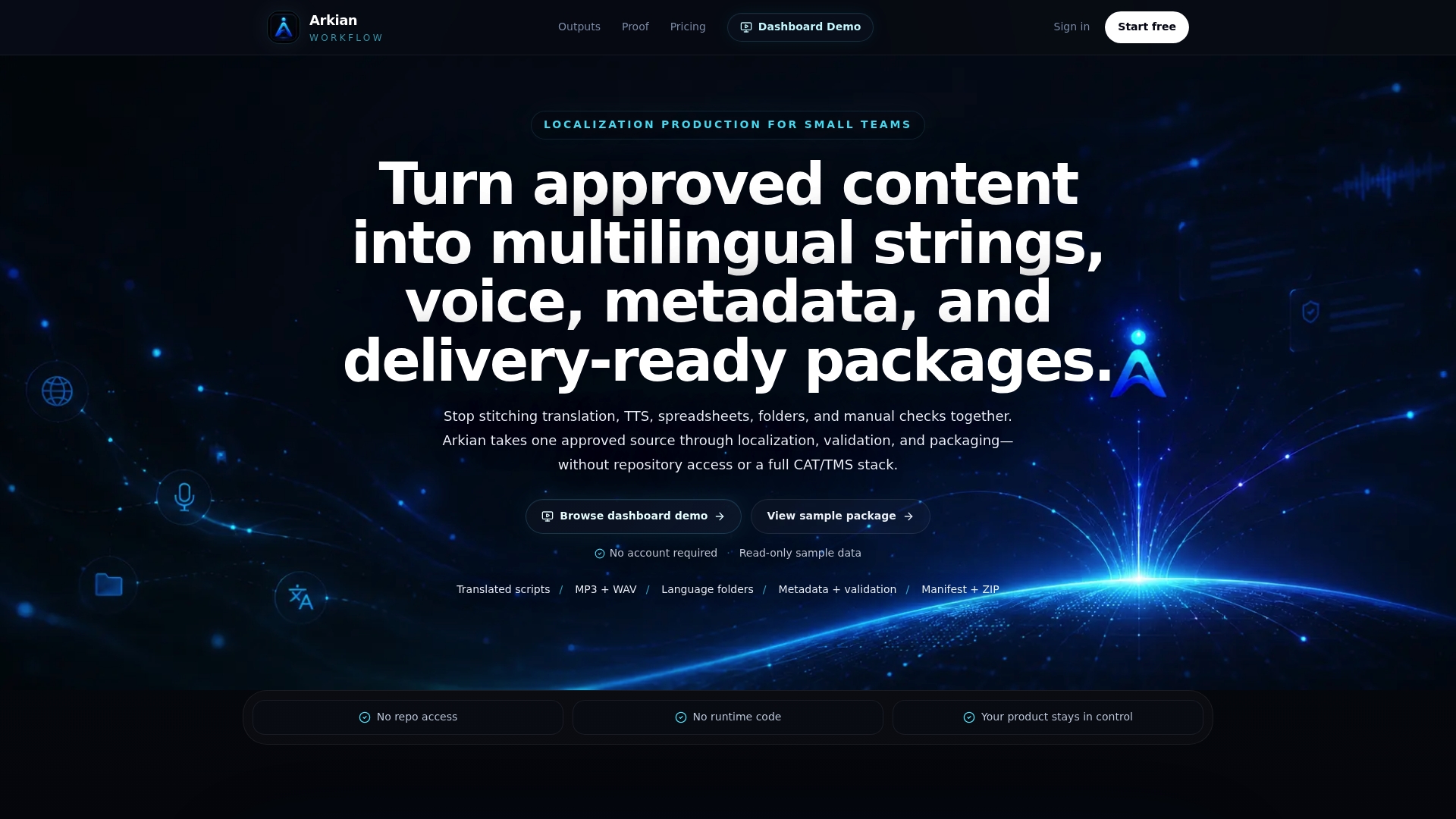
If your app includes narration or in-app voice content, Arkian’s multilingual voice production service generates TTS assets aligned to the same locale packages, so text and audio ship in sync. For teams focused purely on string files, the structured packaging workflow validates and bundles your JSON, .strings, or XML exports automatically. Arkian’s membership pricing and credit pack options are detailed on their pricing page for teams that prefer different payment models. Review the localization strings page to see format options, or read the Quiet Harbour case study to see a packaged delivery in practice before starting your first job.
Docs and Tools Worth Bookmarking
A handful of primary sources cover the platform-specific commands and screenshots this article can’t fully reproduce:
- Play Console’s translation help center for automatic translation settings and preview steps.
- Android Studio’s Translations Editor guide for consolidating and marking string resources.
- Python’s gettext documentation for marking conventions used across many non-Android stacks.
- The okturtles strings extractor repository for a working extraction example.
- i18n-ally for VS Code for inline editor review and bulk translation.
Sources
- Translate and localize your app - Play Console Help
- Localize the UI with Translations Editor | Android Studio
- okturtles/strings
- gettext — Multilingual internationalization services — Python 3.14.7 documentation
- i18n-ally-next (GitHub)
FAQ
What Are String Translations in App Development?
String translations are the process of converting the user-facing text stored in an app’s resource files, like strings.xml or .strings files, into other languages while keeping the underlying code untouched. Developers mark these strings in code, extract them into structured files, and translate each file per target locale.
What Is the Best App for Translating Text?
There’s no single best app; the right choice depends on whether you need a quick manual translation or a full production pipeline. For packaging validated, reviewer-ready multilingual language files without repository access, Arkian is built specifically for that workflow, while IDE plugins like i18n-ally suit developers who want inline translation help while coding.
Is There a Way to Automatically Translate an App?
Yes. Play Console can automatically translate app strings using Gemini models every time a new bundle is uploaded, with a preview step before publishing. Editor plugins and dedicated localization platforms offer similar automated drafting, though human post-edit is still recommended for tone and terminology accuracy.
Is There a Free App That Can Translate Text Live?
Several consumer translation apps offer free live text and camera translation for personal use, but they aren’t built for structured app development work like resource files, placeholders, or plural rules. For actual app strings translation, free tooling like Android’s built-in Translations Editor handles structured files better than a general translation app ever will.
How Do I Handle Pluralization and Gender in Translated Strings?
Use ICU plural syntax in your base resource files so each locale’s grammar rules apply automatically, since languages vary from two plural forms to six or more. Gender agreement usually requires separate string variants per gender rather than a single placeholder, since MT engines frequently guess wrong without that context.