
Hotfix Localization in Hours for Small Teams Without Repo Access
Hotfix Localization in Hours for Small Teams Without Repo Access

A hotfix localization process must produce validated, per-locale runtime files (JSON, .strings, Android XML, YAML), plus any generated audio bundled with a manifest that ties each file back to source keys, locale tags, release ID, and checksums. Basic validation (placeholder parity, plural branch checks, schema and encoding checks) happens before handoff, and none of this requires granting anyone repository access.
TL;DR:
- Validated runtime files must include locale-specific JSON, .strings, Android XML, or YAML named files, plus a manifest linking files to keys, checksums, and release info.
- The initial steps require a source change set with stable keys, target locales, context notes, TTS specs, and readiness of manifest templates; skipping them risks runtime failures.
- Automated validation and sign-offs—including schema, completeness, rendering, and voice playback—are mandatory before packaging, ensuring no critical errors remain.
- The manifest schema must detail source version, release ID, locale list, asset types, stable keys, runtime formats, and checksums, facilitating repository-free traceability.
- Automation platform support speeds up the hotfix cycle by generating multilingual scripts, voice outputs, and validated packages without codebase access, ideal for small teams on tight deadlines.
Table of Contents
- A quick kickoff checklist to scope your hotfix localization
- Step-by-step execution from intake to handoff
- Technical rules that prevent the costliest failures
- Checks and sign-offs before a package ships
- Manifest schema and package layout for repo-free delivery
- How automation shortens the hotfix cycle
- What actually matters in a hotfix localization cycle
- Arkian: a direct path to delivery-ready hotfix packages
- FAQ
- Sources
A quick kickoff checklist to scope your hotfix localization
Before any translation starts, gather a short list of inputs so the job does not stall halfway through. Small teams often lose a day just chasing down what should have shipped with the request.
- Source change set with stable keys, not full files: only what changed.
- Target locales, platform output formats, and the release ID this hotfix belongs to.
- Context notes or screenshots for any string that could be read two ways.
- TTS voice and locale requirements, if spoken audio is part of the release.
- Confirmation that the manifest template, placeholder flags, and baseline resource file are ready to check against.
Required outputs mirror the inputs: a bilingual interchange file for review (XLIFF or JSON with locale metadata), runtime files per locale, audio files with encoding metadata where applicable, the manifest itself, a couple of preview assets, and a short release note.
Step-by-step execution from intake to handoff
A hotfix moves through six stages, and skipping any one of them is usually where runtime breakage starts.
- Intake. Extract only the changed strings, scripts, or metadata fields, attach context and stable keys, and list every target locale and platform output you need.
- Normalization. Canonicalize locale tags to BCP47, lock down the stable key format, and settle on placeholder syntax and markup rules before anyone translates a single word. Build the manifest skeleton now, not after translation.
- Translation. Produce a bilingual interchange artifact, preferring XLIFF 2.2 or JSON carrying locale metadata, since the format is built to hold extracted source text, translations, and the notes a reviewer needs alongside them. Preserve named placeholders exactly and allow argument reordering where grammar demands it.
- TTS production. Translate spoken scripts first, then layer in SSML for pauses, pronunciation, and emphasis, choosing voice and output encoding (MP3 or WAV) explicitly. Microsoft’s SSML documentation and the platform’s text-to-speech docs both treat synthesis as a last step, run only after the script and markup have been reviewed, never before.
- Validation. Run automated schema and placeholder parity checks, confirm completeness against the baseline resource file, and sample-render each locale to catch anything that looks right in isolation but breaks in context.
- Packaging and handoff. Emit runtime files per platform with encoding and schema metadata attached, add the manifest and checksums, include preview assets, and write a release note the release manager can act on without asking follow-up questions.
Pro Tip: Treat the manifest as the first deliverable, not the last. Writing it before translation starts forces you to decide locale tags, key formats, and output formats while they are still cheap to change.
Technical rules that prevent the costliest failures
Most hotfix localization failures trace back to a handful of habits that are easy to avoid once you know to watch for them.
- Never build a sentence by concatenating translated fragments. Author complete sentences per locale instead, since word order and agreement rules shift between languages in ways concatenation cannot handle.
- Use named placeholders and ICU MessageFormat-style plural and select constructs so arguments can be reordered and pluralization follows each language’s own rules rather than English’s.
- Keep the default, unqualified resource file complete. Android’s localization model falls back to that default file when a locale-specific string is missing, so a gap there can surface as a runtime failure in production, not just a missing translation.
- Respect format quirks: JSON needs explicit locale metadata and encoding declared, iOS
.stringsfiles need escaped quotes and consistent newline handling, Android XML lives underres/values-<locale>/strings.xml, and YAML and TypeScript files each carry their own indentation and escaping rules that break silently if ignored.
Checks and sign-offs before a package ships
A hotfix package earns release status only after it clears both automated and human review.
- Automated: schema validation, placeholder and token parity, file encoding checks, locale tag normalization, and a checksum comparison against the manifest.
- Functional: completeness against the baseline resource set, rendering of every plural and select branch, a sample UI pass per locale, and audio playback plus SSML verification where voice is involved.
- Sign-off: a product owner checks contextual rendering, and a native reviewer or pseudo-localization pass spot-checks the riskiest strings, backed by a short release note and a few preview screenshots or audio snippets.
ICU’s localization guidance recommends separating interchange artifacts from runtime files entirely, keeping a bilingual record for review while emitting clean, schema-checked runtime files for the app to consume. That separation is what makes a repo-free handoff possible in the first place. For teams running their own pre-launch review, the QA checklist for testers and devs covers the broader release-validation steps that sit alongside localization-specific checks.
Manifest schema and package layout for repo-free delivery
The manifest is what makes a hotfix traceable without anyone touching your repository. At minimum, it needs the source version, release ID, the full target locale list in BCP47 form, asset types per locale, the stable keys that changed, expected runtime formats, and checksums with file sizes for every artifact.
- Structure the package as one folder per locale, holding runtime files, an audio subfolder where relevant, and a copy of the bilingual interchange file for review.
- Keep preview assets and a single manifest at the package root, never duplicated per locale.
- Map each source key to its translated key and the generated asset filename, so anyone can trace a string from origin to shipped file in one lookup.
- Attach a short release note describing scope and how to test the change, since that note is often the only context the release manager gets.
How automation shortens the hotfix cycle
Our platform at Arkian automates the parts of this workflow that usually eat the most time: generating multilingual scripts, producing voice output, and assembling structured, validated packages without requiring access to anyone’s codebase. We support JSON, iOS .strings, Android XML, TypeScript, and YAML output, and our collaboration with the Quiet Harbour app shows the same validated-package approach applied to a live multilingual release. For small teams running hotfixes on a deadline, this means the manifest, the validation pass, and the runtime files can arrive together instead of as separate chores.

What actually matters in a hotfix localization cycle
The conventional advice on hotfix localization spends too much time on translator management and not enough on the artifacts themselves. Vendor selection, review cycles, and glossary governance matter for a quarterly release. They matter far less when you have hours, not weeks, and a handful of strings to ship correctly.

What actually prevents breakage is treating keys, placeholders, and locale tags as a fixed interface the way an API contract is a fixed interface. Translators can change words freely inside that contract; nobody should be changing the contract itself mid-hotfix. Teams that skip the manifest step because “it’s just a few strings” are the ones who end up debugging a missing plural branch in production at 2 AM.
If you prioritize one thing, prioritize the completeness check against your baseline resource file before anything else. A missing key is invisible in a code review and obvious the moment a real user hits it.
— Arkian
Arkian: a direct path to delivery-ready hotfix packages
The platform was built around exactly this problem: small teams that need multilingual strings, voice, and metadata turned into validated, delivery-ready files without opening up a repository or standing up a translation management system.
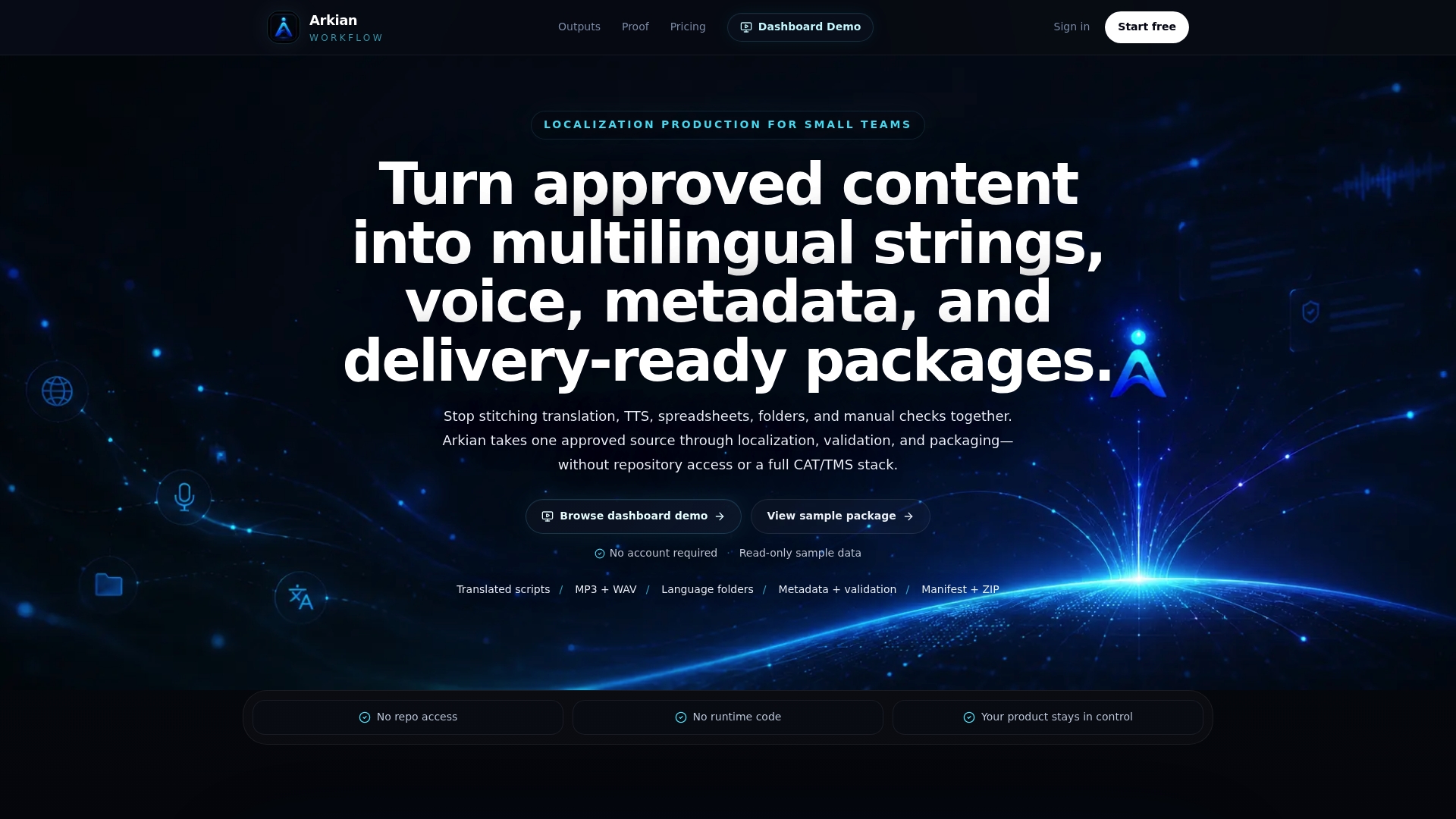
Our localization strings, multilingual voice production, and structured packaging services each handle one piece of the workflow above, and our Starter plan is a reasonable place to run your first hotfix job and see the manifest and validation output firsthand.
FAQ
What files should a hotfix localization package always include?
A complete package includes per-locale runtime files in your platform’s format (JSON, .strings, Android XML, or YAML), a manifest linking each file to source keys and checksums, and any generated audio with its encoding noted. A bilingual interchange file, often XLIFF 2.2, should accompany the package for review purposes.
Do we need repository access to localize a hotfix?
No. Structured resource files, a manifest, and a clear list of changed keys are enough to run a localization pass without granting repo or console access. Platform documentation for exporting and re-importing localized metadata, such as Google Assistant’s localized publishing flow, shows this separation working in practice.
How do placeholders and pluralization get handled safely?
Use named placeholders and ICU MessageFormat-style plural and select constructs so each language can reorder arguments and apply its own plural rules instead of forcing English’s two-category system onto every locale. Translators should work with complete sentences, never concatenated fragments.
What causes runtime failures in localized hotfixes?
The most common cause is a missing key in the default, unqualified resource file, since Android’s fallback behavior depends on that file being complete. Malformed placeholders, incorrect locale tags, and unverified plural branches cause the rest.
How does Arkian fit into an existing hotfix workflow?
Our platform generates the translated strings, voice assets, and structured packages a hotfix needs, then validates and packages them for direct handoff, without requiring access to your codebase. Pricing starts with a Starter plan, available as a one-off purchase, alongside a monthly membership option for ongoing work.
Sources
- XLIFF 2.2 (OASIS)
- MessageFormat | Android ICU reference
- Speech Synthesis Markup (Microsoft)
- Localizing with ICU (Unicode/ICU)